The economic, educational, medical, and social costs caused by the government lockdown during Covid are becoming more obvious. A flood of reports is describing the damage that is increasingly visible.
Hopefully this will be first in a series of posts describing government imposed destruction.
A few articles describing the devastation in education:
6/21/23 – Wall Street Journal – Pandemic Learning Slide Continues for 13-Year-Olds, Making Full Recovery Unlikely– The destruction of learning for a generation of students is becoming visible in test scores. The National Assessment of Educational Progress report for testing during the last half of 2022 shows the willful devastation imposed by the educational and political world.
Math scores for seventh and eighth graders dropped to the lowest point since 1990, while average reading scores only dropped to the lowest level since 2004. There is a loss of 32 years progress in math and 19 years progress in reading.
An unarmed LGM-30G Minuteman III intercontinental ballistic missile launches during an operational test Sep. 23, 2014, at Vandenberg Air Force Base. (U.S. Air Force photo/Joe Davila)
The 44th Strategic Missile Wing was decommissioned on July 4, 1994.
All of the Launch Facilities (LF) except one were decommissioned. All equipment was removed and the site was filled in. All of the Launch Control Facilities (LCF) were decommissioned except one.
On a recent trip to the Black Hills of South Dakota I noticed two fenced areas and quickly realized they had the configuration to be an LF. The fencing was in place but there was nothing visible above ground and there was no signage on the fence.
On the return trip I kept an eye out for those two sites, stopped, and took some pictures.
The following text is a transcription of the Stone Engraving of the parchment Declaration of Independence (the document on display in the Rotunda at the National Archives Museum.) The spelling and punctuation reflects the original. Courtesy of the National Archives.
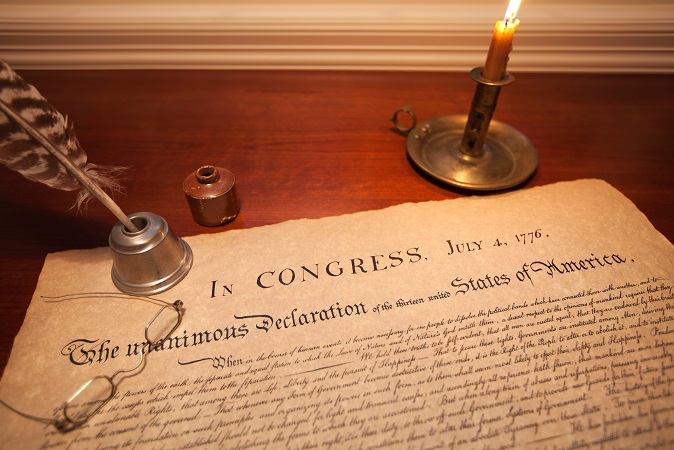
The Declaration of Independence with a candle holder, glasses and a quill pen. Image courtesy of Adobe Stock.
In Congress, July 4, 1776
The unanimous Declaration of the thirteen united States of America,
When in the Course of human events, it becomes necessary for one people to dissolve the political bands which have connected them with another, and to assume among the powers of the earth, the separate and equal station to which the Laws of Nature and of Nature’s God entitle them, a decent respect to the opinions of mankind requires that they should declare the causes which impel them to the separation.
We hold these truths to be self-evident, that all men are created equal, that they are endowed by their Creator with certain unalienable Rights, that among these are Life, Liberty and the pursuit of Happiness.–That to secure these rights, Governments are instituted among Men, deriving their just powers from the consent of the governed, –That whenever any Form of Government becomes destructive of these ends, it is the Right of the People to alter or to abolish it, and to institute new Government, laying its foundation on such principles and organizing its powers in such form, as to them shall seem most likely to effect their Safety and Happiness. Prudence, indeed, will dictate that Governments long established should not be changed for light and transient causes; and accordingly all experience hath shewn, that mankind are more disposed to suffer, while evils are sufferable, than to right themselves by abolishing the forms to which they are accustomed. But when a long train of abuses and usurpations, pursuing invariably the same Object evinces a design to reduce them under absolute Despotism, it is their right, it is their duty, to throw off such Government, and to provide new Guards for their future security.–Such has been the patient sufferance of these Colonies; and such is now the necessity which constrains them to alter their former Systems of Government. The history of the present King of Great Britain is a history of repeated injuries and usurpations, all having in direct object the establishment of an absolute Tyranny over these States. To prove this, let Facts be submitted to a candid world.
Need to catch up on discussion on devastation caused by government policies in response to the Covid pandemic. Two articles from last year are still timely because they describe the deliberate effort expended by the public health community to destroy the reputation and create severe skepticism of anything they ever say.
Read this article a year ago and reread it today (6/19/23). I am more staggered today than a year ago at her arrogance, ignorance, willful deception of the US president, and willful deception of the US public.
Remember this is the person that completely ignored travel restrictions and size restrictions in order to travel several states away to have a four generation Thanksgiving celebration. There was a time that you want to post to leave your state and certainly not have more than 10 people of your immediate family at any gathering of any sort.
Her goal all along was complete lockdown of the entire country for an indefinite period of time. She had no concern, nary any indication of the least bit of awareness, of the economically devastating, educationally destroying, and society crushing impact of her dictatorial feelings.
So many of my posts during the pandemic pointed out the elite in political, public health, entertainment, and media worlds flagrantly ignored the Covid restrictions they demanded we little people follow.
In a moment I will describe conclusions by the British Parliament that former Prime Minister Boris Johnson was lying through his teeth when he spoke to them trying to rationalize away the weekly social events he held for his staff.
I’ve been wondering for two years why so many elitists were so flagrant in their covid violations. I have developed several hypothesis with increasing level of severe implications.
First possibility, all these folks are flaming hypocrites who believe they are above having to comply with the rules everyone else is forced to follow. They speak soberly of the dangers and risks of Covid along with the steps everyone must absolutely take to protect loved ones and neighbors. Yet they won’t lower themselves to follow those rules.
On March 13, 2020, President Trump signed the order kicking off government mandated restrictions in a failed effort to slow the spread and prevent further infections. On April 10, 2023, President Biden signed an order ending the emergency.
Yes, that is one thousand one hundred twenty-three days of the promised fifteen days to slow the spread.
1,123 days is enough time to have 74 rounds of 15 days spread slowing.
As a gauge of how silly it was to hold open the ongoing emergency, the Senate passed a resolution calling on the President to end the restrictions. Vote was an overwhelming 68-23. The House passed a similar resolution by 229-197 vote.
It will take decades to count the full cost of the damage caused by all the government imposed dictats allowed in the guise of slowing the spread. Areas which need study to determine the extent of harm include lost education of children, disrupted education of college youth, declining mental health, deteriorating physical health, increased suicides, increased addictions, deteriorated supply chains, damaged economic production, soaring inflation, labor shortages, lost freedom, damaged churches, disrupted spiritual health, and drop in economic vitality.
Rap video from a few years ago showing the failed arguments for Keynesian economics and the consequences of messing around with the money supply and artificially forcing interest rates low.
Pushing down interest rates leads to mal-investment in projects that are not really good plans. When interest rates eventually rise, lots of plans need to be abandoned.
The results? “Bailouts, payouts, and machinations.”
The ‘cheap credit dog’ will come back to bite hard.
When the economy is flooded with trillions of dollars during COVID, the fully expected inflation forces the Fed to raise interest rates, in turn dropping vaue of bonds and then in turn tanking the value of the securities portfolio of every bank in the country. No wonder the FDIC and FRB think Silicon Valley is just the first bank to go.
The 10 Key Campaigns of the American Revolutionby editor Edward Lengeland a collection of contributing authors is a delightful description of key fights in the battle for American liberty and freedom.
A side discussion in the text is pertinent to the ongoing debate over the Second Amendment.
The book explains every free male in the colonies from the age of 16 up to 60 was required to report annually for training as a part of the militia.
Re-enactment of Battle of Monmouth. Image courtesy of Adobe Stock.
The American Revolution is a delight to study. A few tidbits from Edward Lengel and the contributing authors inThe 10 Key Campaigns of the American Revolutionare relevant to this blog. Some fun stuff:
Perseverance in face of ongoing reversals.
Paying Continental soldiers in specie, that means silver.
Next post will discuss What is a “militia?”
Perseverance in face of ongoing reversals.
Author points out George Washington had more losses in battle than wins. In spite of that he led the patriot forces to victory over the greatest world power of the time.
An overarching feature that shows throughout the book is perseverance in face of trials, tribulations, and battlefield defeats.
The Wagram (1810) – a first-rate 118-gun ship of the line of the French Navy, of the Ocean type. Illustration of the 19th century. Image couresy of Adobe Stock.
In addition to the agonizingly long time it took to cross the Atlantic Ocean in the time of sail, the journey carried risk of sickness, especially from scurvy caused by the lack of fresh vegetables.
Edward Lengel provides an illustration in his book, The 10 Key Campaigns of the American Revolution.
On May 2, 1780, the first wave of French troops left France, arriving in Newport Harbor on July 11, 1780. The trip took 70 days.
There are many things you could not say in public two or three years ago, all of which are now safe to say. Here is a starting point of the list of things you can now talk about in the open:
As I find articles to further develop the issues now say to say, I will have further discussion.
The virus came from a lab leak.
This was crazy talk three years ago but is slowly becoming accepted: the most likely place the COVID-19 virus came from was a Chinese research laboratory. Oh, by the way, said lab was funded in part by Dr. Fauci’s department.
There are many things you could not say in public two or three years ago, all of which are now safe to say. Here is a starting point of the list of things you can now talk about in the open:
A slow trickle of news reports are showing that lots of the crazy, coo-coo bird, nutzo, conspiracy theory wackiness you heard from your friends two or three years ago were actually correct. My friends deemed nuts by society who were saying these things were right.
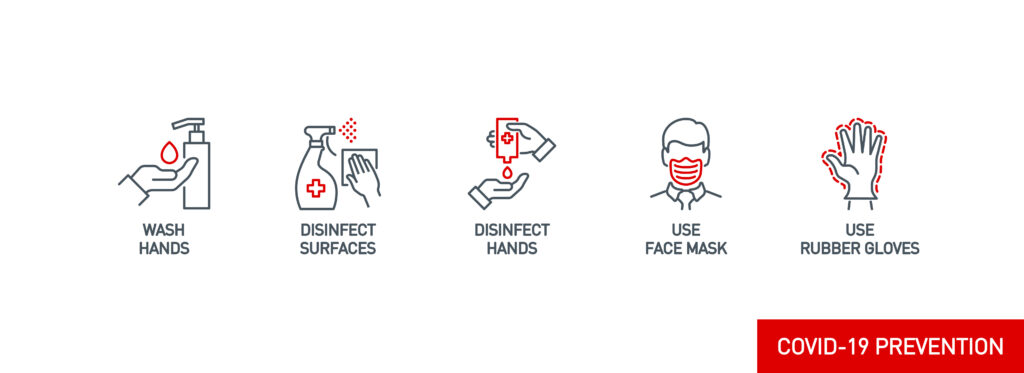
Of the above five preventions, we have long known that #2 was not needed. We now know #1, #3, and #4 also had no value. Image courtesy of Adobe Stock.
There are many things you could not say in public two or three years ago, all of which are now safe to say. Here is a starting point of the list of things you can now talk about in the open:
Masks don’t work.
Natural immunity works. (next post)
The virus came from a lab leak. (upcoming post)
There is a disturbing pattern emerging, which further corrodes credibility of the entire public health sector.
A slow trickle of news reports are showing that lots of the crazy, coo-coo bird, nutzo, conspiracy theory wackiness from two or three years ago was actually correct. Turns out my wacko friends who were saying these things were right.
Masks don’t work.
Previously discussed this study as covered by a couple of other reports:
Article cites a study which analyzed 78 research reports, all of which were randomized control trials. Researchers say those little paper masks we were wearing for so long made little or no difference. They can find no evidence for positive impact.
How about those expensive N-95 masks? Same thing. No impact.
What about those studies which did show masks made a difference which were cited as proof positive that anyone who disagreed mask efficacy was a Neanderthal?
Reports are now surfacing there are far more people dying then we would expect now the pandemic is mostly behind us. This discussion will bring up merely two articles calling attention to this issue.
First article points out there are excess deaths after the pandemic has wound down. Second article points out there were excess deaths in California during the pandemic.
I suggest we need to look at government policies during the pandemic as the driving force behind the excess deaths.
Normally, one can look at the five-year average of deaths and make an estimate of the number of people who will die this year. It is called “excess deaths” when the actual deaths are above the five-year average.
Three years after the start of the pandemic there are significant excess deaths in countries with believable statistics available.
Article says there were 18% excess deaths in the first two years of the pandemic. Now that the deaths from Covid have dropped, the overall death rate should be back to the historical average.
Yet that is not what is happening.
Author points out that England and Wales were showing 1000 excess deaths weekly in 14 of the previous 15 weeks. None of those are from Covid.
Excess deaths are running in the 10% up to 20% level around the world.
Excess death rates are 8% in the US and 20% in Brazil.
There is a surge of articles denouncing pandemic policy along with emerging research showing the destruction caused by intentional government policy.
I have made note of many of these articles and hope to start discussing them.
In this post:
Metastudy of 78 randomized control experiments finds masks have no benefit.
Pro-mask is anti-science. Anti-mask is pro-science. (Pro-mask is actually a religion.)
Our political, public health, educational, and religious leaders have much to answer for.
2/10/23 – The Spectator – I’m pro science. That’s why I’m anti-mask– The former brand president at Levi Strauss was hounded out of her job because she had the audacity to ask, in a company that presumably doesn’t actually hire any toddlers, whether a mandatory mask for toddlers was harmful.
She was accused of being “anti-science.” Oh the horror! Off with her head!!
Research from the Cochran study, which will be discussed more later, analyzed 78 studies covering 1 million people. The conclusion?