With experience, complex technology is second nature whether in 1805 or 2012

I was staring at a sailing ship wondering how a person could figure out how to control all the lines to set the sails at the correct angle to power the ship. From my non-sailor perspective, it looks incredibly complicated.  How could you keep track of which rope does what and change it correctly to get the sail to do what you want.

While vacationing in San Diego, I enjoy touring the Maritime Museum. In addition to seeing a Soviet era submarine, it’s fun seeing the Star of India sailing ship and the replica H.M.S. Surprise, which appeared in the movie Masters and Commanders – the far side of the world.

While in San Diego last week, I pondered how to sail a large ship.

Continue reading “With experience, complex technology is second nature whether in 1805 or 2012”
What if Bakken and Eagle Ford with new production of 1 million barrels a day are just the beginning?

What if new production of one million barrels of oil per day from just two fields is just the opening round of new production in the US?  What if that is just the start of worldwide growth in production?

I just took a first glance at Oil: The Next Revolution – The Unprecedented Upsurge of Oil Production Capacity by Leonardo Maugeri.

Consider this:

Continue reading “What if Bakken and Eagle Ford with new production of 1 million barrels a day are just the beginning?”

“Peak Oil” assumes we will never find a new field, so what just happened in Liard Basin can’t happen – peak oil #6

The Peak Oil concept is that production has peaked, production levels will soon decline in the U.S. & worldwide, and we will soon run out of oil.  At a fundamental level that assumes there isn’t any more oil than what we know about right now and that we can’t get to anything that we don’t know how to reach now.

Today I provide two illustrations of the fallacy of Peak Oil.

First, a new field means that tomorrow we can get to energy we didn’t know about yesterday.

Continue reading ““Peak Oil” assumes we will never find a new field, so what just happened in Liard Basin can’t happen – peak oil #6”

Travel cost by stagecoach in 1870s – part two

So what was the cost for cross-country travel by stagecoach in the 1870s?

I previously mentioned some of the fun exhibits in the Seeley Stable and Wells Fargo museums in Old Town, San Diego.

Putting together several of the information displays gives this information:

The Butterfield Overland Mail stagecoach run from St. Louis Missouri to San Francisco, California covered 2800 miles.

The fare was $200. 

Travel time was 24 days. That means the overall average travel speed was 3½ or 4½ miles per hour including changing out the horses and rest stops.

Let’s convert that into weeks of salary

Continue reading “Travel cost by stagecoach in 1870s – part two”

Travel cost by stagecoach in 1870s – part one

What did it cost to travel by stagecoach from San Diego to Los Angeles in 1871?  How does that compare to today?

The Seeley Stable Museum and Wells Fargo Museum in Old Town, San Diego offer fun examples of 1800s transportation. Carretas, cargo wagons, Mud Wagon stagecoaches, and Concord stagecoaches.

I picked up a lot of fun information while touring those museums a while back.

Continue reading “Travel cost by stagecoach in 1870s – part one”

Want a personal copy of your favorite sculpture? With a camera and 3-D printer you can make one.

Take hundreds of pictures of your favorite sculpture, drop them into specialty software, touch up the results, and you can print a replica to enjoying your home or office.

That’s where 3-D printing is at right now.

Cosmo Wenman took 1000 pictures of a favorite sculpture and now has a replica he can hold in his hand.

Here is the video:

Through a Scanner, Getty

[youtube=http://www.youtube.com/watch?v=blKcIsEEoag]

Continue reading “Want a personal copy of your favorite sculpture? With a camera and 3-D printer you can make one.”

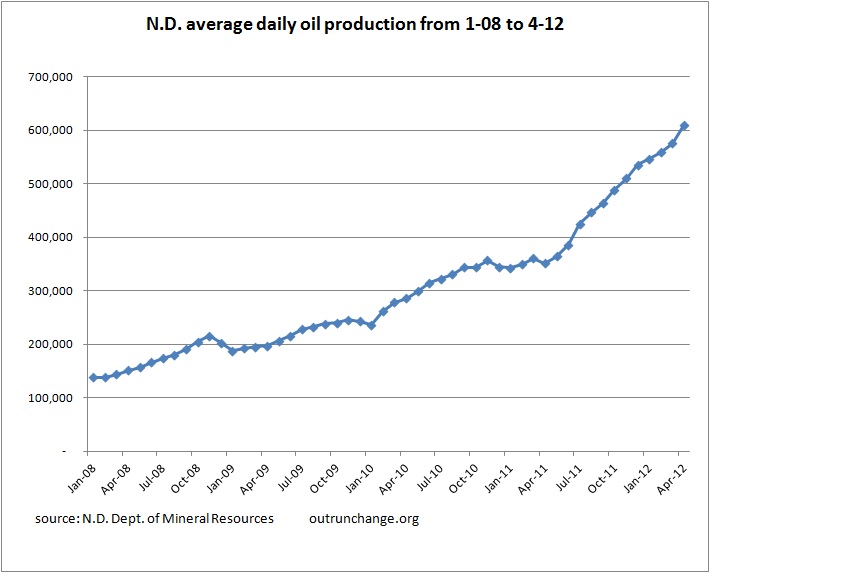
Graphs of North Dakota oil production – April 2012

Here’s a few graphs of North Dakota oil production.

Click on any graph to enlarge.

Average daily production by month:

Annual average of daily production (calculated as total production for the year divided by 365, except for 2012 which is divided by 121): Continue reading “Graphs of North Dakota oil production – April 2012”

Bakken illustrates flexibility of proven reserves and breaks the ‘peak idiocy’ concept – peak oil #5

I’ve been using Daniel Yergin’s Wall Street Journal article There Will Be Oil as the jumping off point to explain that the concept of ‘peak oil’ is invalid.  The posts have been combined into a page. You can click here or click on the “Peak Oil” page at the top of this blog.

Mr. Yergin comments on the Bakken field. Look at the appearance of unknown oil:

In 2003, the Bakken formation in North Dakota was producing a mere 10,000 barrels a day. Today, it is over 400,000 barrels, and North Dakota has become the fourth-largest oil-producing state in the country. Such “tight” oil could add as much as two million barrels a day to U.S. oil production after 2020—something that would not have been in any forecast five years ago.

(I think the stat for 2003 production is far too low, but the underlying point stands strong.)

Notice the unexpected growth in Bakken production? The huge amount of oil behind that 400k per day output wasn’t anywhere in the proven reserve list in 2003. Wasn’t even an idea in anyone’s head.

Continue reading “Bakken illustrates flexibility of proven reserves and breaks the ‘peak idiocy’ concept – peak oil #5”

Typical wages in 1860 through 1890

Found a great resource that provides a frame of reference for wages in the last half of the 1800s. It is from the National Bureau of Economic Research:

Wages and Earnings in the United States, 1860-1890: Wages by Occupational and Individual Characteristics (update: link was broken; works now; document is downloadable)

(Update:  Each chapter in the book is  downloadable :Wages and Earnings in the United States, 1860-1890

Perhaps there are better resources. I’ll go with this.

In table 39, you can find average daily or hourly wages in five skilled occupations. Count this as skilled tradesmen.  In table 43 you can find the average wages for common labor. Count this as unskilled labor, perhaps equivalent to minimum wage today.

I will go with the Aldrich report data which is hourly wages. It appears the standard is 10 hours a day. I will go six days a week to get weekly income.

Here is the average hourly wage: Continue reading “Typical wages in 1860 through 1890”

Sometimes creative destruction does you in, sometimes it is political turmoil far away, and sometimes it is just destruction

A while back my wife and I vacationed in San Diego. I learned a lot of new things in Old Town. That is a state park where many buildings have been renovated to reflect life as it was from 1810 through 1870.

I read a delightful, short history of Old Town titled San Diego’s Beginnings.

One of many fascinating things is the long list of outside pressures that forced massive change on the residents of Old Town.

Continue reading “Sometimes creative destruction does you in, sometimes it is political turmoil far away, and sometimes it is just destruction”

North Dakota oil production passes 600,000 barrels per month, pulling ahead of Alaska by a smidgeon

April production averaged 609,373 barrels per day. That is up 33,883 bopd from March. Number of producing wells is 6,734, which is an increase of 93 for the month.

Stats on oil production from the North Dakota Department of Mineral Resources are here.

Production data from Alaska can be found here.

With April production in Alaska of 18,210,000 barrels for a 30 day month that is an average of 607,000 per day. That means production in North Dakota is very slightly ahead of production in Alaska.

Continue reading “North Dakota oil production passes 600,000 barrels per month, pulling ahead of Alaska by a smidgeon”

Mississippian Lime – another name to watch

This discussion sounds like it’s about Williston, North Dakota:

Oil rigs are springing up in farmers’ fields. “No vacancy” signs hang in the windows of local motels, and a steady stream of trucks barrel through Main Streets. Along the state’s southern border, the once-quiet farm towns are quickly transforming into boomtowns.

Hundreds of workers seeking high-paying jobs are flocking to places like Harper County, which had resorted to paying people to live there because of its declining population. Businesses are coming back from the dead and a housing shortage has caused rents to triple.

That is actually a description of what’s going on in south central Kansas, according to CNNMoney’s article Oil boom strikes Kansas.

Continue reading “Mississippian Lime – another name to watch”