Where the Venezuelan Supreme Court filed that part of their constitution defining the legislative branch. Image courtesy of Adobe Stock.
The Supreme Court of Venezuela ruled that it will take over all of the powers of the Congress. That essentially suspends the Congress and removes the remaining power center in the country that is not under the complete control of the president.
Since the president controls the supreme court and obviously now controls the legislature, there is no organized structure that can oppose him.
That’s a major step.
For more info, check out any of the following articles.
For entertainment, consider the spin some headline writers put into their work:
In Venezuela, that sign is needed at hospital pharmacies, bakeries, and now at gasoline stations. Image Courtesy of Adobe Stock.
The shortages and suffering in Venezuela continues. Your homework for the day: what economic system provides this level of suffering?
Foreign reserves are shrinking
Bakeries threatened if they bake too many sweets and not enough price-controlled bread
Pregnant women are leaving the country to deliver their babies
Gasoline shortages appear
3/1/17 – CNN Money – Venezuela is down to its last $10 billion – The country’s foreign reserves are down to $10.5B, from $20B in 2015, and $30B in 2011. That info in sourced to the Central Bank of Venezuela.
Article says inflation is expected to hit 1660% this year and 2880% in 2018.
3/13 – PanamPost – Venezuelan Regime Threatens to Expropriate Bakeries, Jeopardizing Bread– In addition to price controls and currency controls, the government is going to impose output requirements on bakeries. If they don’t produce bread all day at the government limited price, they are subject to take over by the government. Left out of their miscalculation is that the government has stopped importing wheat flour.
If bakeries don’t bake enough bread, the government will close the shops.
2/19/17 – The Million Dollar Way – EURs – Bakken 2.0 – EUR means Estimated Ultimate Recovery, which is the total amount of oil expected to be extracted from one specific well. Article says the EURs in Bakken were 300K early on. At the point I started paying attention, the EURs were in the 500K range with possibilities of 1,000K.
Article says Mike Filloon has been talking about 1.5M instead of 1.0M.
Now the article lists 14 wells with EURs of 1.5M up to 2.0M EURs.
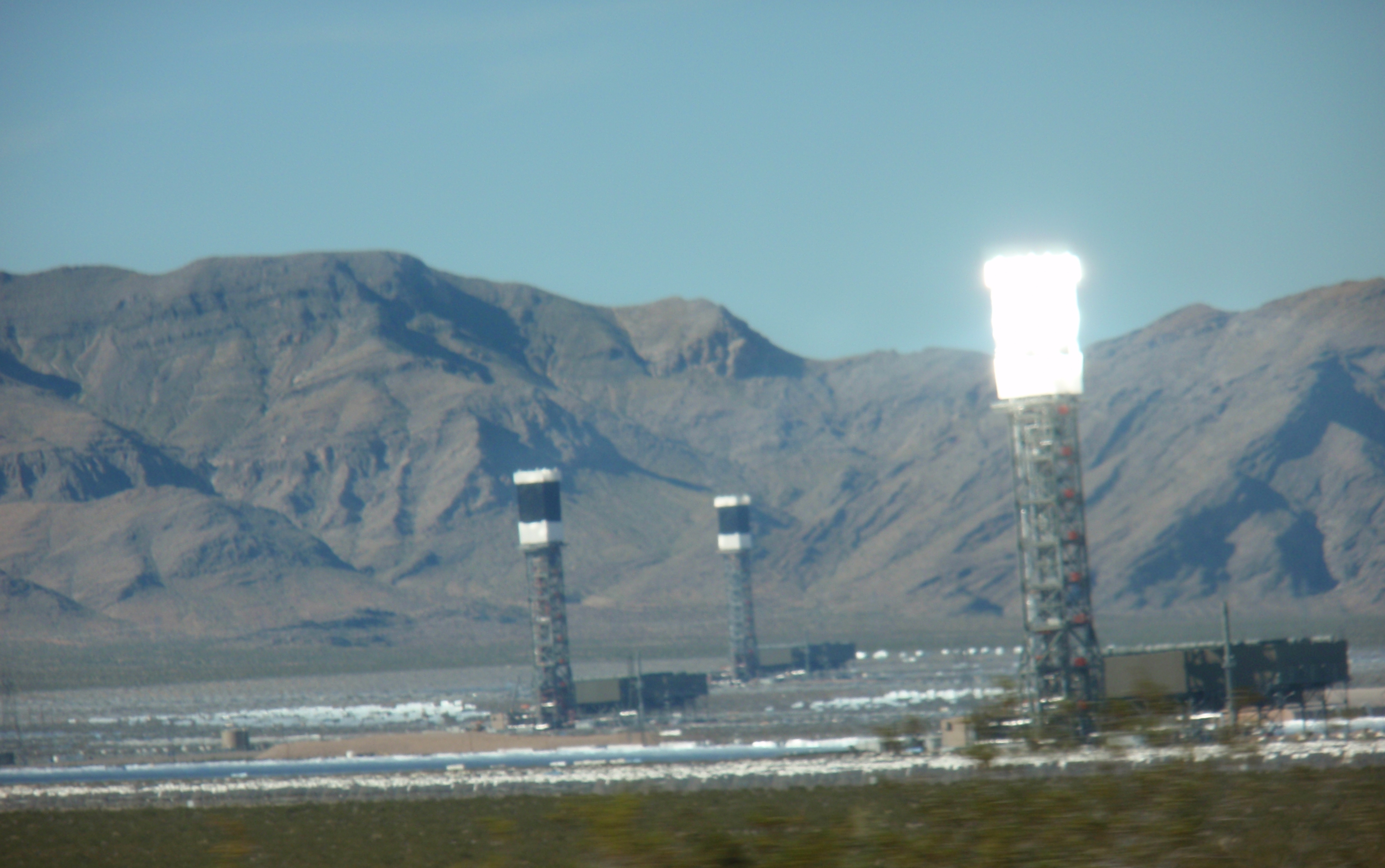
Curtailed electricity in California during 2016 was greater than the output from any one of those towers. Photo by James Ulvog.
The routine surge of electricity during the late morning and early afternoon in California is disrupting the electricity system. Matching the excess production of electricity during the day with highest use in the evening is going to be expensive for consumers.
The underlying issue is solar is neither reliable nor dispatchable. The issue is beginning to be a problem and will get far worse.
3/5/17 – Wall Street Journal – How California Utilities are Managing Excess Solar Power – There is so much solar power in California that when the sun is bright, there is too much electricity and it must be sold cheaply just to get rid of it. Then, when the sun goes down and demand goes up after people get home from work, there isn’t enough electricity and the spot price goes sky high.
Article says that during the day, the wholesale spot price of electricity frequently shrinks to zero. Occasionally the wholesale spot price can hit $1,000 a megawatt-hour after dark. That would be about a dollar a kilowatt. $1.00.
At the end of the article there is a comment that on 178 days in 2016 the wholesale price went negative. The spot was below zero. The solar plants in California had to pay someone to take the excess electricity. I wonder what that does to the bottom line at Ivanpah? (That is a rhetorical question. – Impact on them is zero because I think they are on a multi-decade fixed price contract.)
Huge battery plants can store electricity during the day and discharge at night. That is expensive. Article says the price ranges from $285 up to $581 a megawatt-hour, which is in contrast to a natural gas peaker at $155 to $227 a megawatt-hour. That is around twice as expensive.
3/18/17 – David Danelski of Press-Enterprise at Daily Bulletin – Here’s how California ended up with too much solar power – The amount of solar power now online in California is so high that it is disrupting the electricity market.
The impact of so much solar capacity shows up at two times during the day.
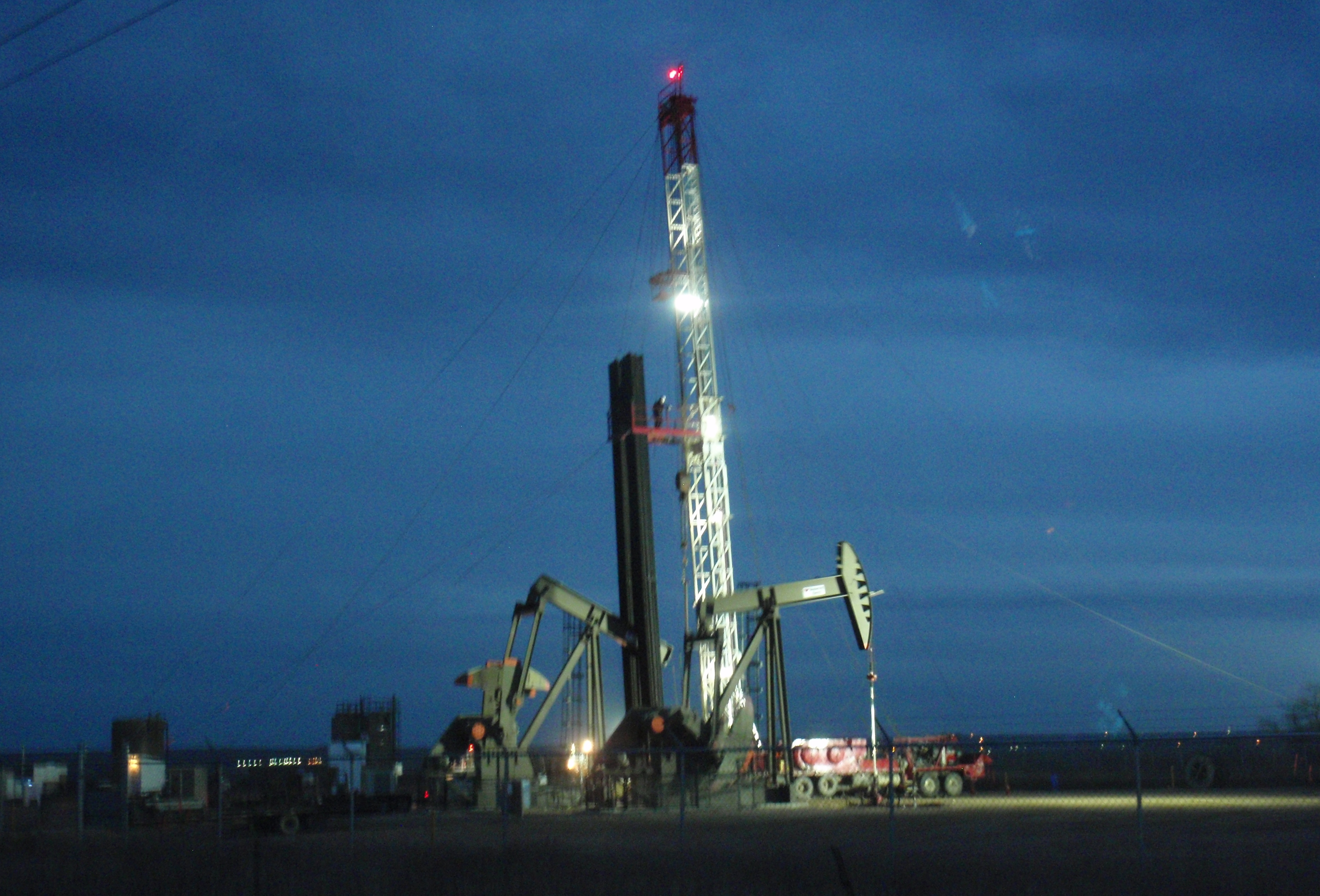
That little ol’ thing, along with 500 similar contraptions, is changing the world of oil production. Photo by James Ulvog.
Looks like we are in the midst of radical change in regional and world politics caused by the technological revolution in oil and gas production. I keep trying to wrap my little brain around what is going on. Here are a few articles that may stretch your brain too.
Brain stretcher on the shift in geopolitics due to increased US oil production
Speculation why the Saudi government’s plan to re-engineer their country’s economy isn’t going to work
Three articles on the rapidly increased US shale production undercutting the OPEC production cut
3/12/17 – PJ Media – The Problem of Success– Article raises the unsettling idea that nobody has figured out the impact of dramatically increased production in the US.
Neither the previous US administration, the current US administration, leadership in Saudi Arabia, leadership elsewhere in the Middle East, nor even pundits for that matter, have figured out how geopolitics will change as Saudi Arabia loses its role as dominant oil producer and the decentralized American drillers gain the swing producer role.
It stretches my brain even to understand there is an issue.
American frackers used the dramatic run up in oil prices to $100 as an opportunity to figure out how to frack oil where it could never have been touched before. They then used the collapse in prices as an opportunity to figure out how to frack far more efficiently, far more effectively, with far higher production output from every well. As a result, the break-even price for U.S. shale has shrunk.
The vast network of independent producers are responding to price changes far faster than OPEC could handle or the majors could ever dream of. Prices go up somewhat and in about three months US production is surging.
15 wells on 1 pad. Notice a drilling rig on right edge of view. September 2015 photo by James Ulvog.
Yeah, I’m still new to this effort of watching the energy field. One of the things that still amazes me is the frequency with which the geology wizards find another billion or so barrels of recoverable oil that ‘we’ didn’t know about and a decade ago couldn’t get out of the ground profitably even if the wizards had known for sure it was there.
First production is expected in 2021, four years from now. Production level expected to hit 120,000 bopd, or 43.8M barrels a year.
Oh, what Peak Oil?
By the way, I’m having a hard time keeping track of all these massive new finds of oil which either nobody knew about a decade ago or it would have been technically impossible to ever get any of it out of the ground.
Successful recovery of Falcon 9 booster during CRS-10 mission. Credit Flickr. Courtesy of SpaceX who has placed their photos in the public domain.
Found an article that summarizes accomplishments and plans for SpaceX and Blue Origin, the space exploration companies of Elon Musk and Jeff Bezos, respectively.
Here are many of the key achievements and targets for both companies. I sorted and regrouped the items that drew my interest. As you consider the list, you can see both companies are making rapid progress. The competition is getting serious.
Illustration of reusable New Glenn lift vehicle from Blue Origin with 3.85M pounds thrust. Credit Blue Origin.
In Behind the Black’s favorite phrase, the competition heats up. Check out the news just this week for Blue Origin becoming a very serious player.
3/7 – Florida Today Blue Origin books first New Glenn launch contract– Eutelsat Communications has booked the first launch on the New Glenn rocket from Blue Origin. First launch is expected in 2021 or 2022, which is only four or five years away.
Most of the current competitors, with a Saturn V for comparison. Illustration courtesy of Blue Origin.
I am astounded at the number of companies taking on the challenge to explore space. It’s staggering to see the innovation emerging.
Check out the number of competitors that are in the game. That is fantastic. The more companies pushing to figure out how to get in space and provide commercially attractive service at a profit, the harder everyone else will push for progress. Good.
Check out that awesome graphic at the top of the page. Lots of thanks and all the credit to Blue Origin. I’ve been looking for something like that visual for a long time. Yeah, you will be seeing it again and again on my blog.
Check out what some of the competitors are doing. This is what I’ve noticed in just the last few weeks:
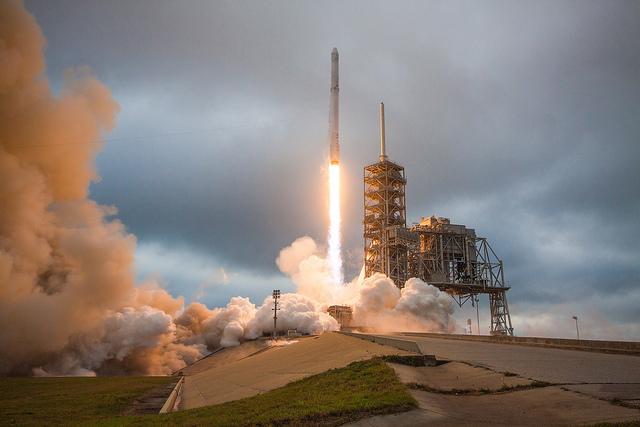
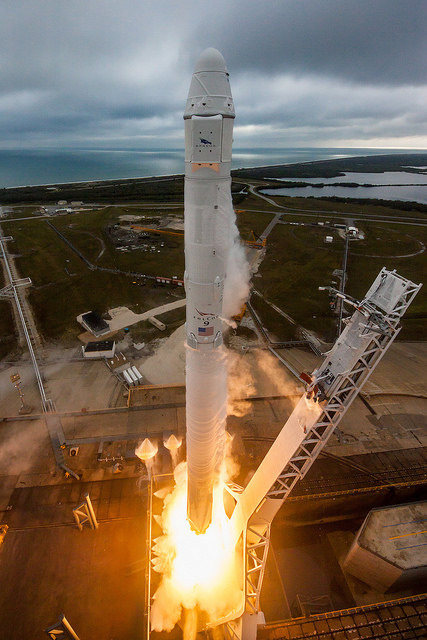
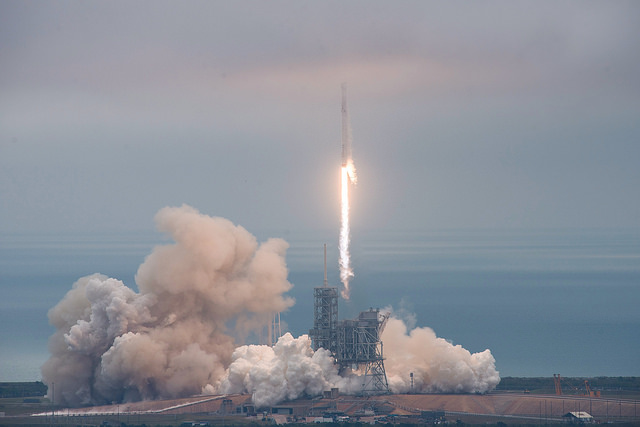
Falcon 9 and Dragon capsule launch. Add two more boosters, an upgraded Dragon 2 capsule, and imagine what could be done. Credit Flickr. Courtesy of SpaceX who has placed their photos in the public domain.
Here’s two articles that stretch the brain:
United Arab Emirates has a goal to establish an inhabited settlement on Mars by 2117 – Such an idea is no longer ridiculous. Ten years ago it would have been foolish; today, it is quite plausible.
A concept of how the moon could be occupied within four years – this is also not a silly idea anymore.
2/20 – Leonard David’s Inside Outer Space – UAE’s March to Mars – The United Arab Emirates plans to have an inhabited settlement on Mars by 2117.
In all seriousness, I say go for it!
They are recruiting a cadre of research scientists for an international team. They plan to launch an orbiter to study the planet more closely. They want to develop a faster transport system. They are already designing a city, which will be robot-built, presumably to be near-inhabitable by the time humans arrive.
Several intriguing articles on military forces using technology:
ISIS using larger drones with larger payloads
Marine Corps wants to experiment with giving an entire battalion suppressors for all their weapons
Pakistan developing second strike capability by putting nuke loaded cruise missiles on diesel subs
Lots of jobs in the US military will be replaced by robots
2/21 – Washington Post – Use of weaponized drones by ISIS spurs terrorism fears– In Iraq, Islamic State is working with drones above the quadcopter size. With wingspans of about 6 feet, the drone can carry a mortar round at about three pounds instead of a hand grenade.
IS has posted videos of multiple uses of the drones to drop explosives. The frequency of offensive use of the drones is high enough that Iraqi troops must scan the scansky for drones and take cover when one is spotted.
Captured documents indicate IS is doing research to develop new drones and modify off-the-shelf versions.
This is a significant step up from my previous discussion of ISIS’ drone usage. On January 30, I mentioned:
Liftoff of CRS-10 mission. Nice view of Falcon 9, Dragon capsule, and location of solar arrays on third stage. Credit Flickr. Courtesy of SpaceX who has placed their photos in the public domain.
The wide open frontier of space exploration fascinates me:
An asteroid 124 miles in diameter is richer in minerals that what we have here on earth – picture the value of those resources for building space ships in space
Five teams from the private sector are in the race to get a team on the moon
ULA trimming work force – trying to gain price competitiveness?
The underlying substance is of interest. NASA has a 2023 launch scheduled for a probe that will check out asteroid Psyche, which is sitting in the asteroid belt between Mars and Jupiter. It is about 200 kilometers across, or about 124 miles in diameter.
Asteroid Psyche is rich in minerals. How rich? If it all could be brought back to earth and sold at current market prices, it might have something in the range of $10,000 quadrillion of minerals. This is compared to a world economy with $73.7 trillion of production.
Shipwreck standing on the beach with the sea in the background. Margarita Island. Venezuela. Photo courtesy of DollarPhotoClub.com
Still more indications the humanitarian crisis continues to deepen:
People killing wild animals just to get a little meat on the table
Government can’t even issue passports
Use the “Maduro diet”, lose 19 pounds in a year
2/10 – Fox News – Venezuelans killing flamingos and anteaters to stave off hunger amid mounting food crisis – Researchers for a university have found 20 flamingo carcasses, each with the breast meat and torso removed. Carcasses of dogs, cats, donkeys, and giant anteaters have been discovered at city dumps. That illustrates the desperation so many people experience in trying to find meet for their diet.
Experts point out those wild animals can carry lots of little nasties that can hurt humans.
Article explains the severity of inflation by providing some data points. Here is what you can buy for half of the minimum wage for an entire month:
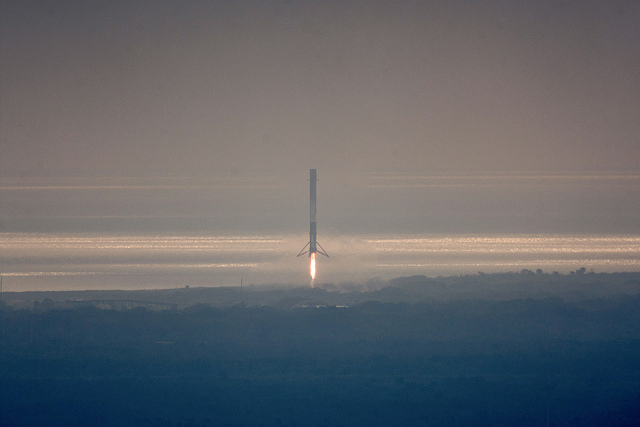
Successful recovery of Falcon 9 booster during CRS-10 mission. Credit Flickr. Courtesy of SpaceX who has placed their photos in the public domain.
Just watched the recovery of a Falcon 9 booster. I missed the launch. Very cool video from the on-board camera as the booster descended through a cloud bank and landed dead center on the pad.
This mission, CRS-10, will deliver over 5,000 pounds of supplies to the International Space Station. Two really cool things. First, a private company providing supply runs to ISS is a thing. Second, it is almost routine to recover the first stage.
Liftoff of Falcon 9 and Dragon capsule on CRS-10 mission. Credit Flickr. Courtesy of SpaceX who has placed their photos in the public domain.
Turmoil continues in Mali. A few recent articles I noticed:
European Union decides to keep their troops in the fight
Another round of retaliation for retaliation
Five countries will add troops to the counter-terrorism efforts in the Sahel
1/19/17 – Strategy Page – Mali; Europe Agrees to Stay and Fight – European Union has decided to keep 500 military trainers in Mali to provide ongoing training to officers and NCOs for the long-term. Article says it takes a decade to professionalize a military force. Corruption is so endemic in Mali and other African countries (I will make a guess same concept applies in Asia and South America as well) that it takes that long to train officers and the NCO cadre to avoid corruption.