Yesterday mentioned there was a big increase in oil production. Up 71,447 bopd in October, an increase of 7.35% for the month.
Here are a few more graphs to tell the story…
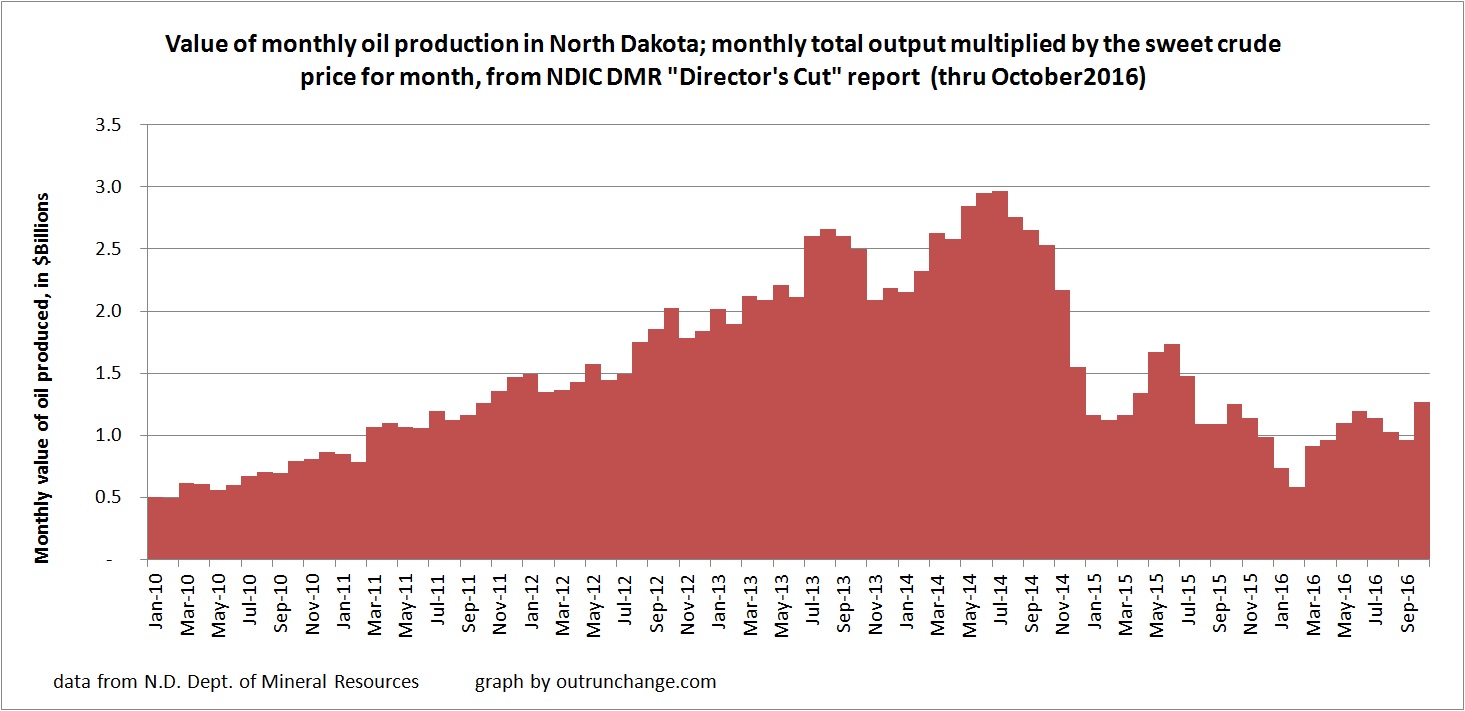
Value of monthly oil production, calculated by multiplying the rate cited in The Director’s Cut for average wellhead price in the state multiplied by average daily production. Amounts are in billions of dollars.
Average daily price in the state. This feeds the previous graph. Notice the substantial up tick in the last several months.
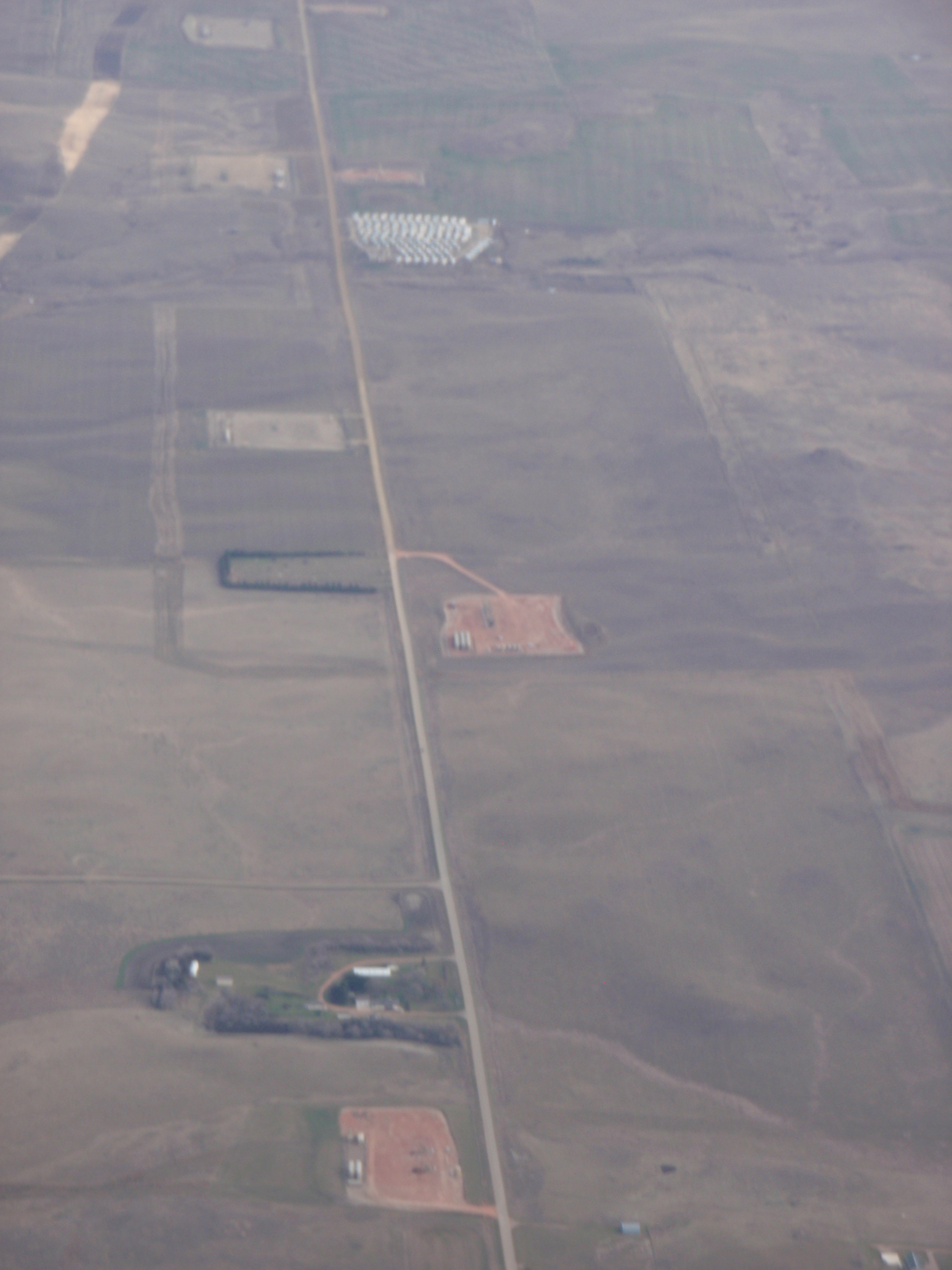
Those pads are just lined up so nice and neatly for mile after mile on each section line. Ponder the millions of gallons of gasoline each well will generate. Photo by James Ulvog.
Production saw a big increase in October. Output climbed from 971,760 in September (final) to 1,043,207 (preliminary). That is a 7% jump, moving production across the 1M point. That is a big increase. Why? Then some comparisons, then a couple of graphs.
Lynn Helms attributes the increase to operators opening up wells that had been throttled back and a few big wells coming on line, according a quote in the Wall Street Journal, North Dakota Crude Oil Output Rises to a Five-Month High. Yeah, the WSJ quoted Mr. Helms. They ran an article the day of his press conference to discuss the monthly report. How ‘bout that?
That is an increase of 71,447 bopd, the largest increase in one month going all the way back to 1989. Other months with increases of 40K bopd or more were:
54,065 – September 2014
52,099 – June 2014
50,845 – July 2013
42,653 – February 2013
That is an increase of 7.35%. Going back to 1989, the only months with a higher increases on a percentage basis were:
One graph illustrates the inflation rate in Venezuela and the other represents economic performance. Image courtesy of Adobe stock.
Government will withdraw all 100 Bolivar notes from circulation after Wednesday, tomorrow. The level of suffering will increase even further.
12/4 – AP – Venezuela to issue larger bill as currency continues to melt– Article says the central bank has announced they will issue bills in the 500 to 20,000 Bolivar range. This follows up on previous reports saying they were planning to do so.
The exchange rate is now 4,587 Bolivars to the dollar.
Article says that is a deterioration by a factor of five in the last year.
The official exchange rates are 10 and 663 to the dollar.
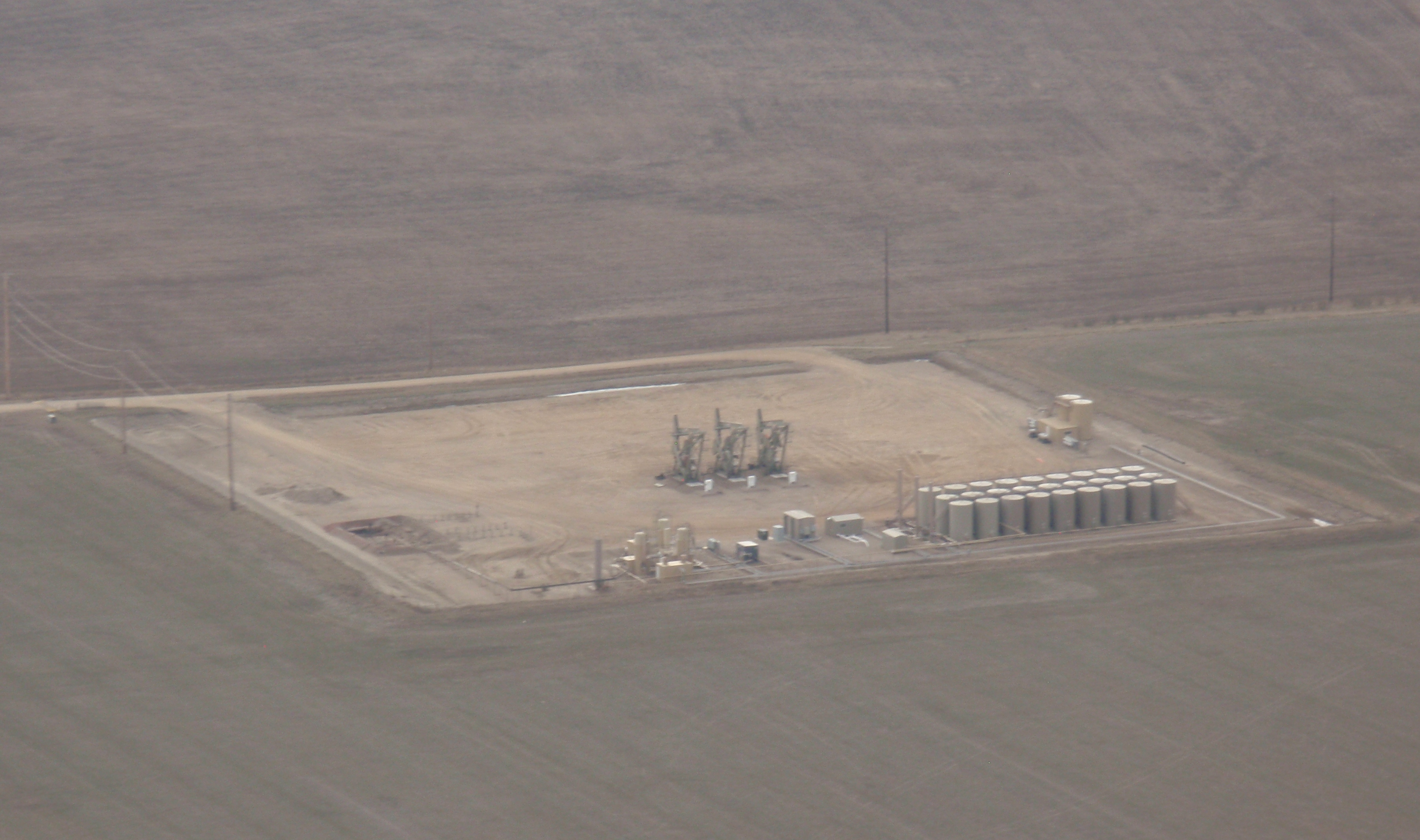
Expect to see more of those pump jacks soon. By the way, there is room for several more wells on that site. With all those storage tanks on site, there are going to be a lot more wells there eventually. Photo by James Ulvog.
This oil situation getting more complicated:
Saudi Arabia is going to diversify their economy. By moving into refining?
Consensus is only half of the OPEC cut will be realized
Non-OPEC producers agree to 588K bopd cut
Output from China is in natural decline – 300K bopd drop in 2016 and another 200K bopd in 2017
What diversification? 12/1 – Wall Street Journal – Saudis Wager On Higher Oil Prices to Drive Economic Diversification – The new leader of Saudi Arabia has a long-term plan to transition the economy away from exporting crude oil towards an entrepreneurial economy. According to this article, the first major step in diversifying the economy is a major push into refining and mining.
Maybe it’s just me, but I don’t think that expanding from exporting crude oil to refining crude oil is much of a diversification. Likewise, it is not a big jump to extracting minerals from the ground when the current focus is extracting oil from the ground.
A new well is likely to produce about a million barrels of oil, compared to half a million from a well drilled several years ago. Photo by James Ulvog.
A few articles of late:
2 hotels closed in Williston
Ground broken for new Williston airport
Each Bakken well now expected to produce a million or 1.5 million barrels of oil
9/27 – Williston Herald at Dickinson Press – Two Williston hotels closing their doors – An owner of two hotels with total of 105 rooms will be closing them this week. Both are on the market, for $3.0M and $3.2M. One of them reportedly had drugs sales and prostitution on site during the boom.
Don’t worry too much about capacity. There’s a huge number of hotels open in Williston, especially compared to three or four years ago. Also, those hotels won’t be going anywhere. When the drilling picks up, someone else can pick up those empty hotels for a real bargain. When the space is needed, they will be open.
10/10 – Amy Dalrymple at Oil Patch Dispatch – Williston Breaks Ground on New $240 Million Airport – Construction is underway for the new airport. It will have a 7,500 foot runway and four gates at the terminal. The new airport will be able to handle planes that can hold 165 passengers instead of the 50 passenger jets in use at the current airport.
Currently there are five daily flights into Williston, which is down from 11 at the busiest time of the boom.
12/4 – Million Dollar Way – The Bakken: How Things Stand Near the End of the Year 2016– The productivity increase in the last few years is staggering. Here are a few tidbits from the article, which is a survey of recent quarterly releases from the drilling companies.
Estimated Ultimate Recovery, EUR, is the amount of oil to be drawn from the well, I believe with only primary recovery. A few years ago (2011), the typical EURs were 550K barrels from middle Bakken and 450K from Three Forks bench. Continue reading “Random updates from Bakken”
In a decade or so, will we get to see thousands of these above the Green River Formation? Photo of Bakken pump jack by James Ulvog.
Here’s another brain stretcher for you in the realm of the open frontier in energy – how about using microwave to tease oil shale out of the ground?
11/4 – Oxy – Move Over Fracking, There’s a New Technology in Town– First, keep in mind that oil shale is not the same as shale oil. I have to wrap my brain around that every time the topic of oil shale comes up.
Shale oil is crude oil that is trapped in rocks. Fracking is the way to get shale oil out of the ground.
Oil shale is sort-of-like crude oil stuff (actually kerogen, but that label doesn’t register for me) that has to be heated, or cooked, out of the rock. Usually done by strip mining then cooking the stuff. Other option is steam injection to liquefy the oil shale which then can be pulled out of the well. Fracking won’t do the trick.
Try this on for size: Using microwaves comparable to the power of 500 household machines to heat the rock turning the oil shale liquid. The water, which is mixed in with the kerogen will be converted to steam, which in turn will help pull the liquefied oil to the wellbore.
The time for transit from New York to Washington and back home is described. For comparison, I’ll repeat the timing for a trip by William Sherman described in another book, which I mentioned a while back.
Here are the transit times:
43 days – New York to San Francisco via Isthmus of Panama – 1852
51 days – San Francisco to New York via Panama – 1854
198 days – New York to Monterey, California sailing around Cape Horn – 1847
West-bound trip
Lieutenant Grant’s unit was transferred from Michigan to the Washington territory.
At the time, there were three options for the trip. First was overland via the Oregon Trail. Second, sailing around Cape Horn at the tip of South America. Third, portage across the Isthmus of Panama.
Concept drawing of vehicles SpaceX plans to use for trips to Mars. Tanker is sitting at left ready to be added to booster upon its return. Credit: Flickr, SpaceX has placed this in public domain.
SpaceX is planning to use the above equipment to get to Mars, while NASA is planning to recreate the early accomplishments of this equipment:
Apollo capsule. Image courtesy of Adobe Stock.
Consider the contrast between the following two reports.
In the private sector, scientists are working to figure out how to set up an infrastructure to support asteroid mining.
At NASA, scientists are working to repeat the mid-60s task of getting a crewed spaceship out far enough to loop around the moon; not land on the moon, just fly around it. In other words merely repeat part of what they did fifty years ago.
You know things are horribly bad when the New York Times and Washington Post are frequently reporting on the economic devastation in the socialist paradise of Venezuela.
11/25 – New York Times – Venezuelans Flee in Boats to Escape Economic Collapse – Mass numbers of people are fleeing Venezuela by foot, air, and now on rickety boats. The lack of food, water, electricity, and medical care is driving people away, reminiscent of the flood of people paddling away from Cuba on tied-together inner tubes.
Here are the details from the press release. The “reference” is the baseline agreed upon, which is referred to as the “Reference Production Level” in the press release. The change by country is listed. I calculated the percentage change for each country. Here are the changes:
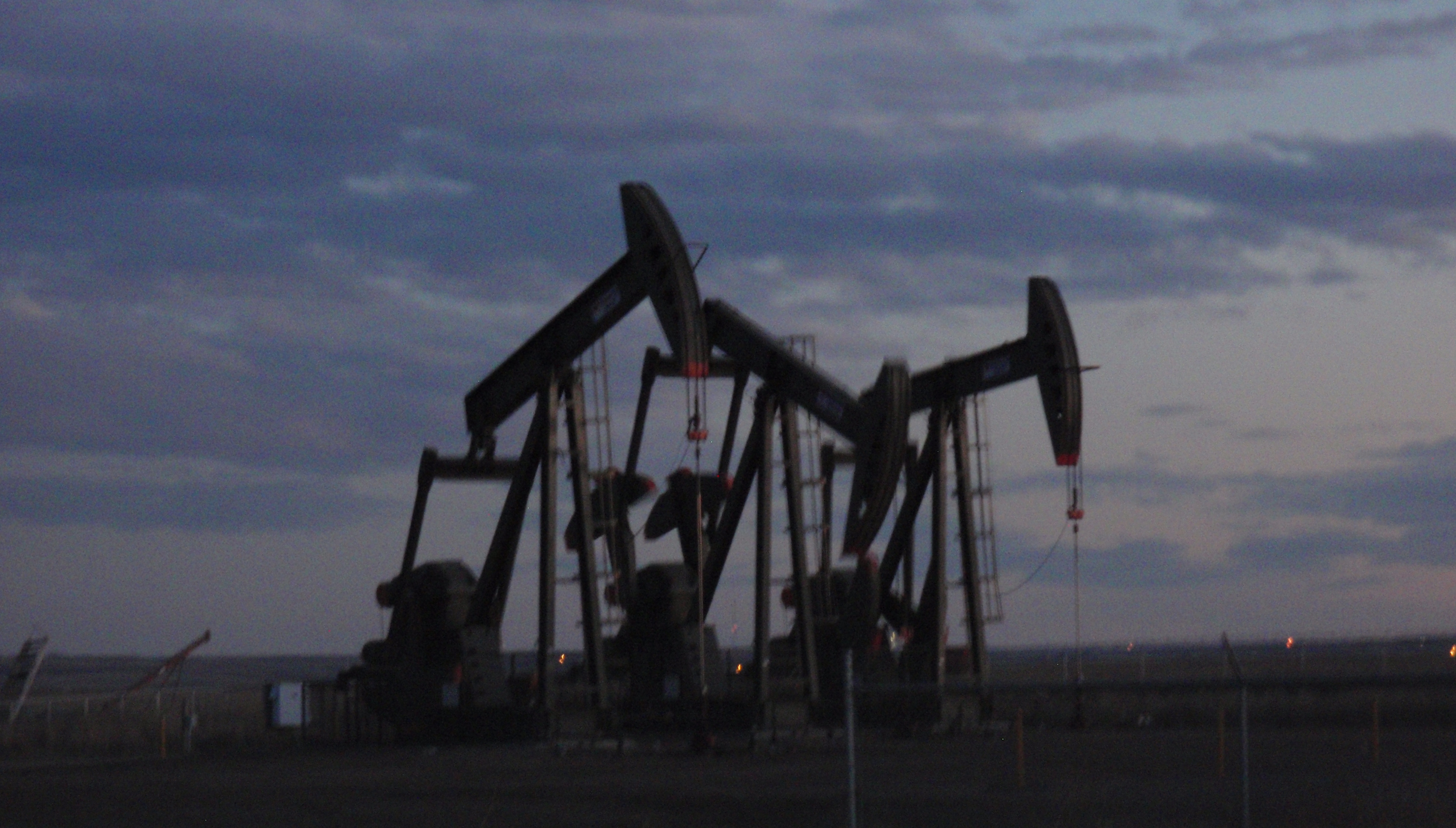
My guess? Today’s production deal means we will see far more of these things in Bakken and Permian Basin. Photo by James Ulvog. Oh, by the way, that will be a good thing.
My prediction: if the announced target price of $55 to $60 is reached there will be lots of drilling rigs moved out of US parking lots and into the field.
Out of focus photo by James Ulvog. (Yeah, yeah, I know – don’t give up my day job.)
First article below says that predicting oil prices is a fool’s errand. The payoff of trying to do so, it seems to me, is it requires diving into the dynamics and trying to understand the production and demand aspects underlying the price of oil. Second article below delves into the dynamics.
Mr. Oksol agrees with the major points: OPEC’s effort (meaning Saudi Arabia) to shut down shale producers has been unsuccessful. They tried this once before back in the 1980s.
On the second point, he agrees shale producers will respond fast to any rise in prices.
Author agrees that the phrase “big bet” is an acceptable way to describe the Saudi strategy to take out shale producers but thinks a more accurate description would be “trillion dollar mistake.” As for me, either description works well.
How much damage has Saudi Arabia caused the shale drillers? In other words will they be able to respond to any change in prices are they out of the game.
If the answer is yes, how fast will shale drillers be able to respond?
Just got back from a visit to Williston to see family during Thanksgiving week. Had a delightful time. Even got to drive around the oil field a little bit.
Got lots of new photos. A lot!
I reeeeeeally lucked out and glanced out the window at just the right time. Got a bunch of photos of the wing-toasting facilities at Ivanpah.
For example:
Ivanpah Solar Electric Generating System. November 2016 photo by James Ulvog.
During the rain and overcast that start afternoon on Saturday and ran until around sundown on Sunday, the towers probably weren’t quite so bird-killing white-hot.
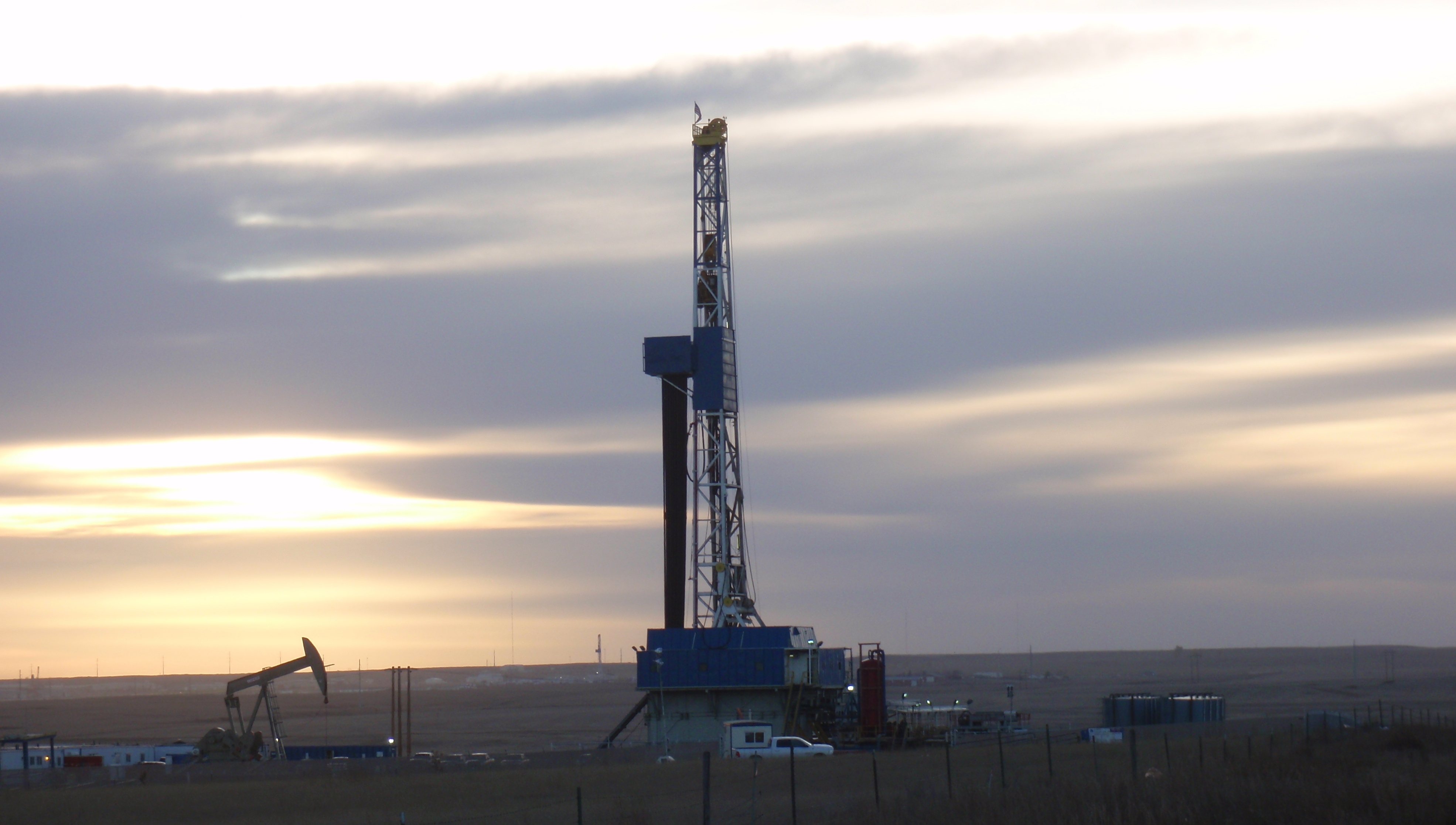
Drilling rigs
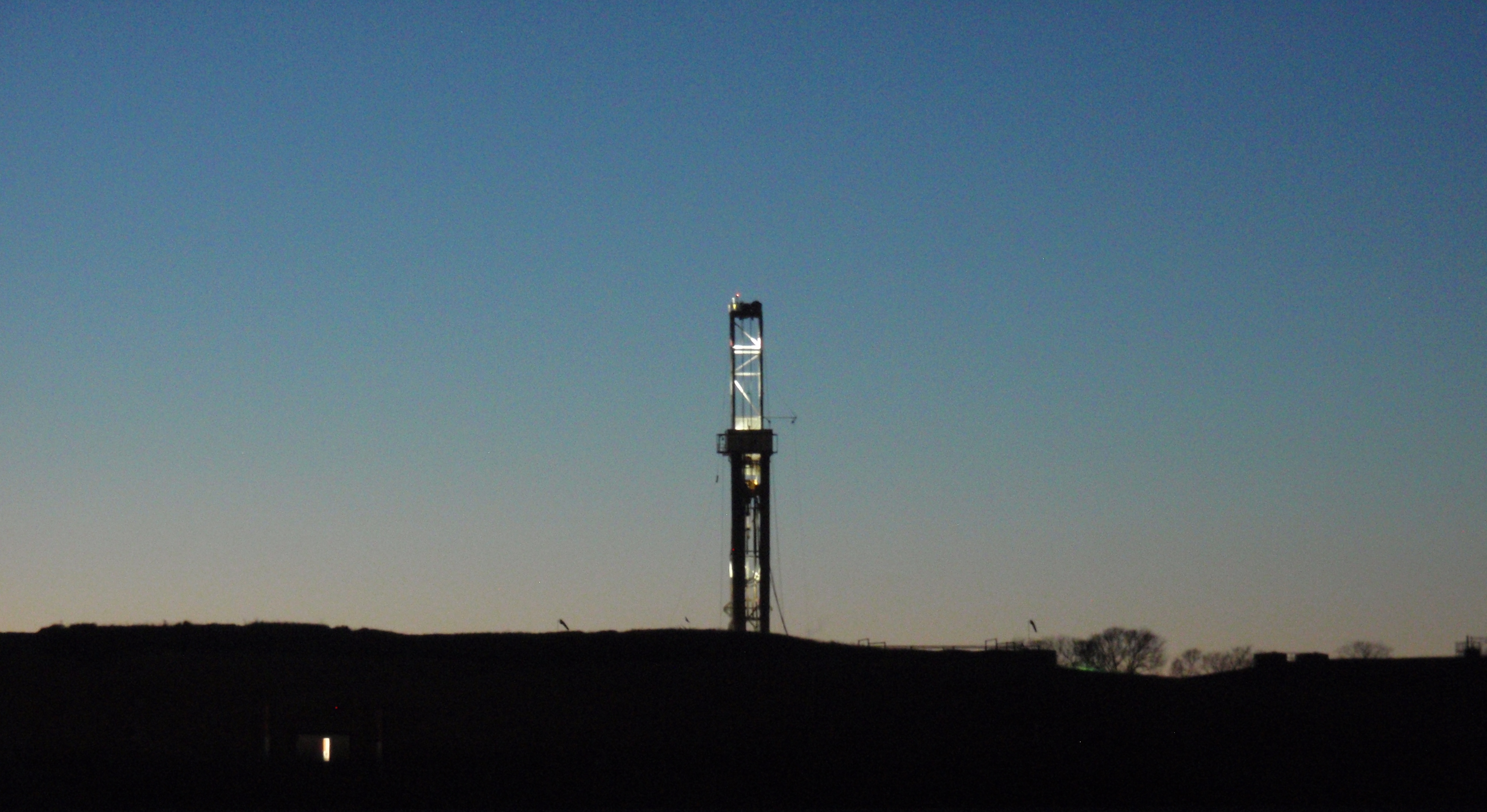
There is one rig in the city of Williston and two rigs a mile or two north of town.
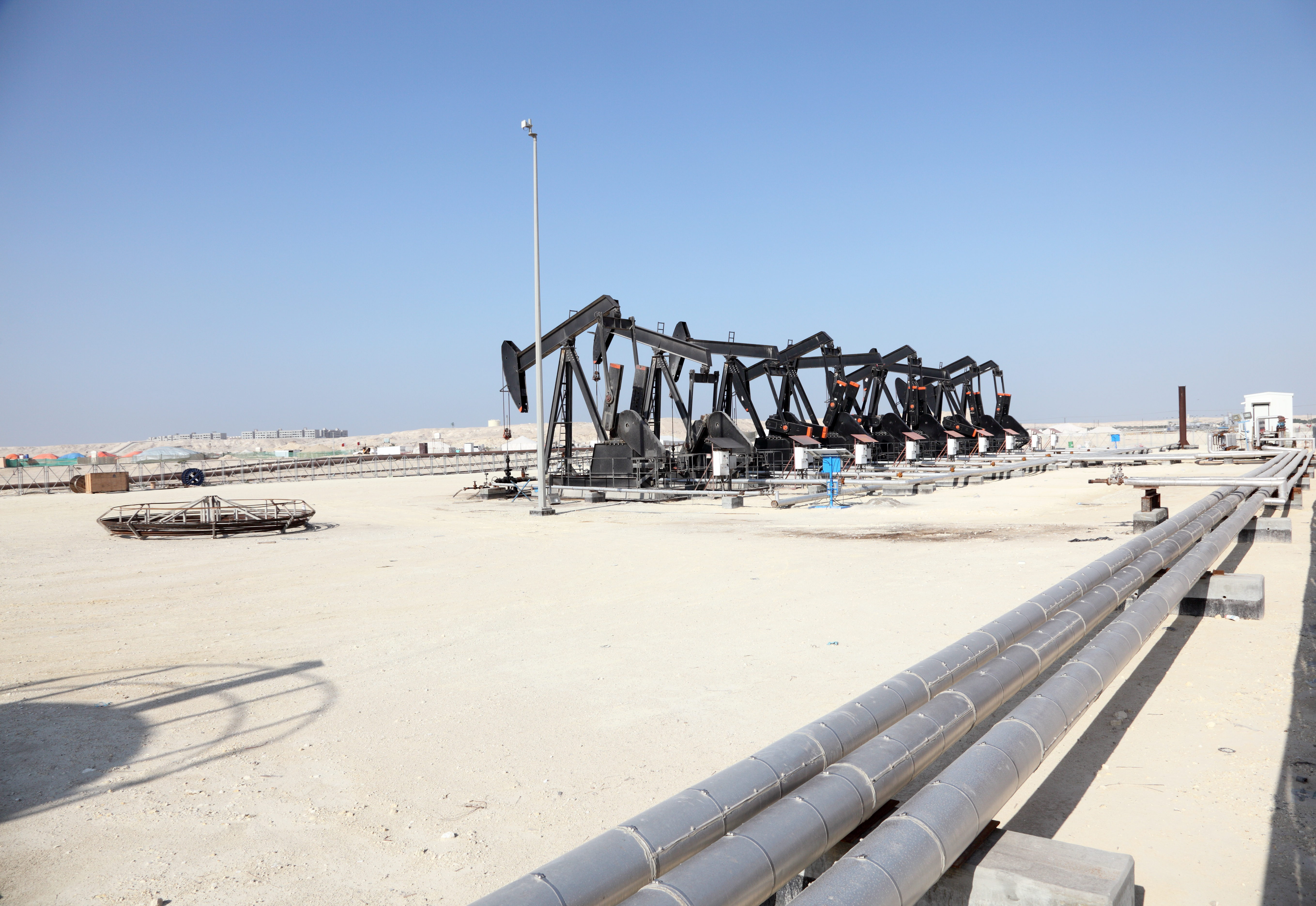
Oil pump jacks in the desert of Bahrain, Middle East. Photo courtesy of Adobe Stock.
Keep in mind that U.S. shale drillers will be able to make a lot of money if oil prices go up to $60 as I describe the distress facing Saudi Arabia.
Four articles for your consideration:
Shale drillers likely to get busy if oil hit $60
Saudi Arabia still in distress in spite of successful bond issue
One Saudi official cautions bankruptcy could be a few years off if oil prices continue the way they are
Another article describing the distress in Saudi Arabia because of low oil prices
11/16 – Reuters – IEA expects US shale output rise if OPEC pushes oil to $60 – IEA expect there will be a lot more drilling and production coming out of shale fields in the US if prices go up to $60. If OPEC (meaning Saudi Arabia) reduces production sufficiently to drive up prices it will draw shale drillers back to work.