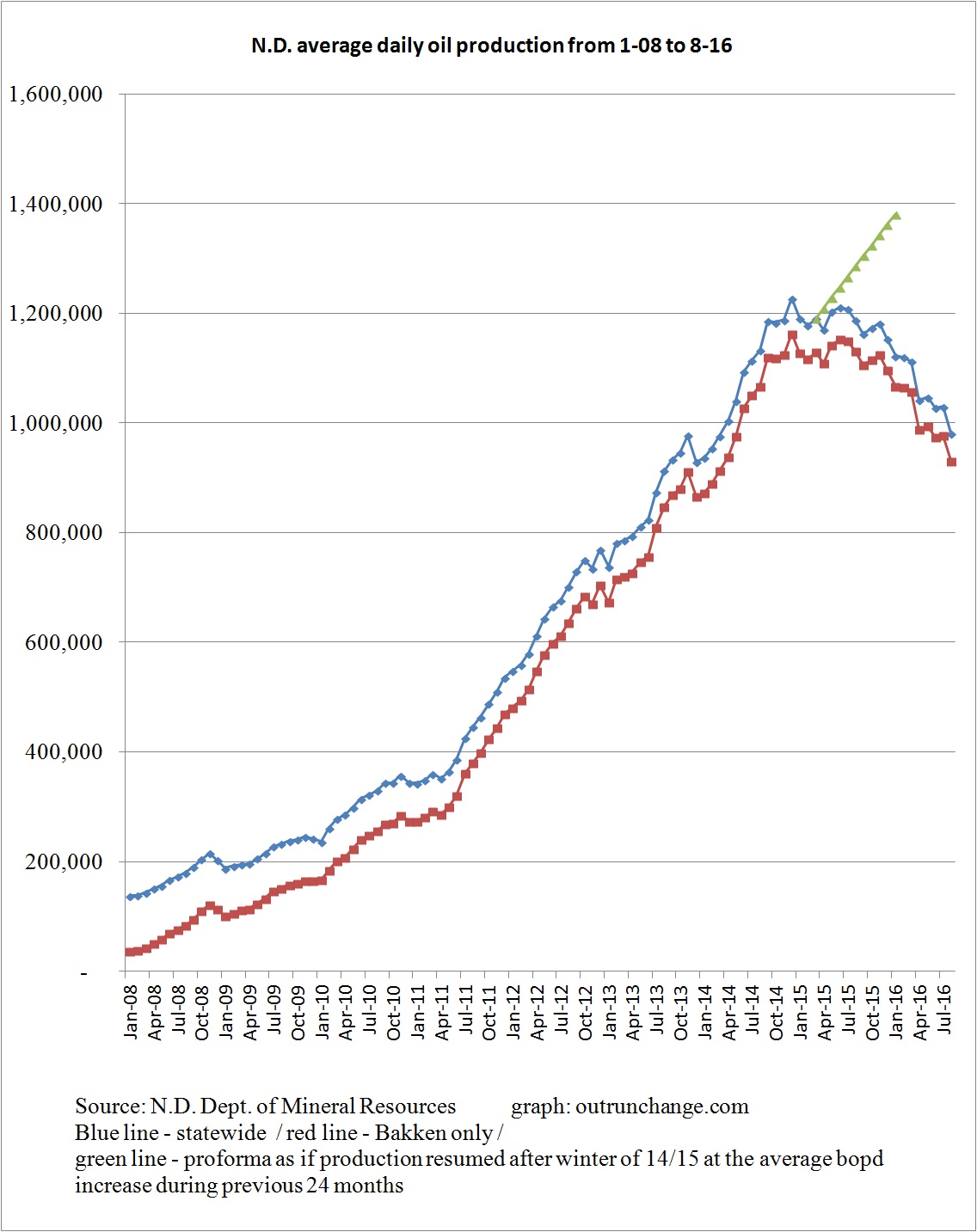
Above graph shows the average daily production in North Dakota statewide and in the Bakken field. Output in August dropped from 1,029,734 barrels of oil per day (bopd) (revised) to 981,039 bopd (preliminary), a change of 48,695 bopd, or 4.73%.
This is the first month with average daily production below 1 million bopd since March 2014.
Here is the average daily production by month since 2004:
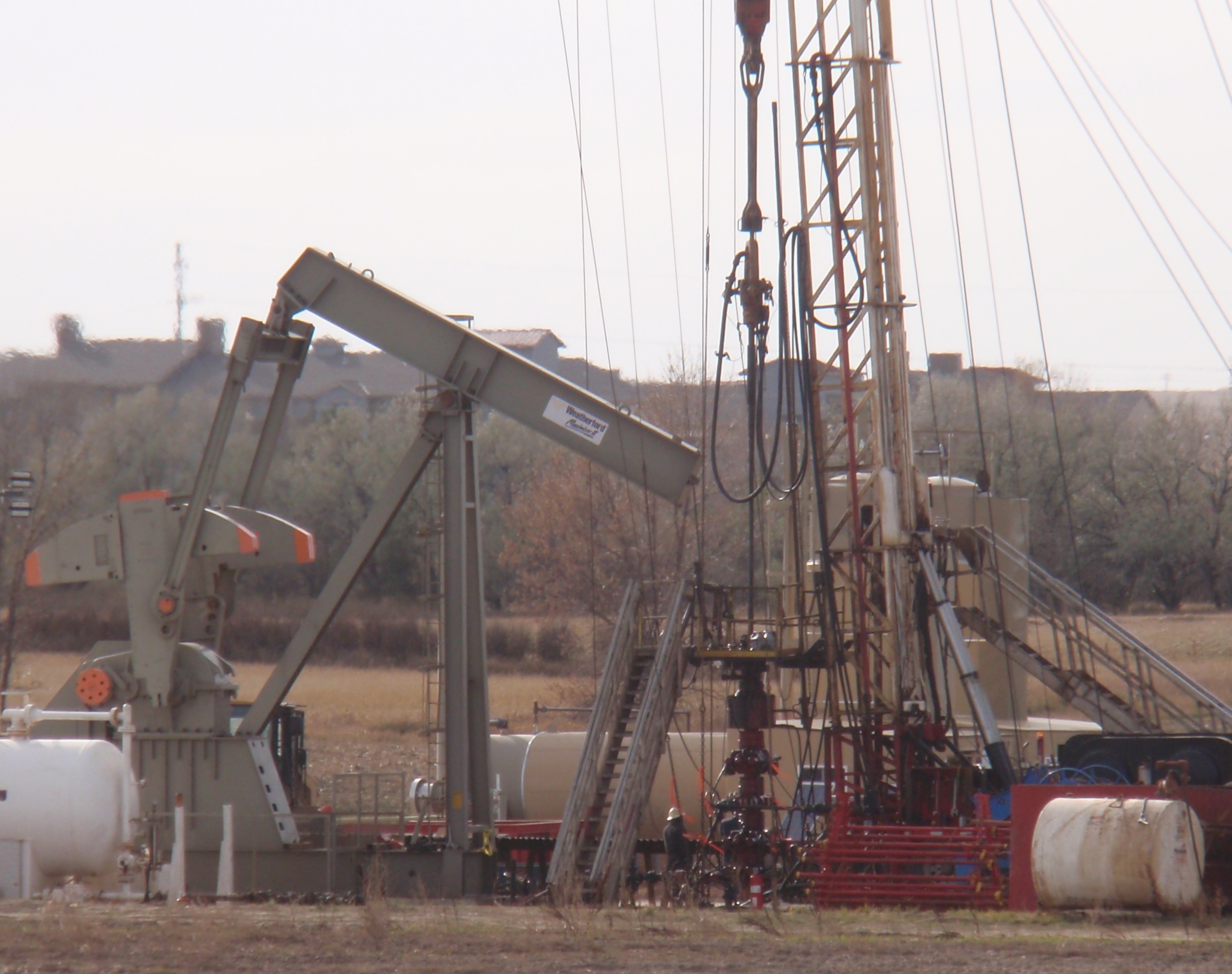
Workover rig in October 2014. Photo by James Ulvog.
In contrast to the horrible news mentioned yesterday from Venezuela, consider the the amazing news from the open frontier of energy production. The benefits produced by fracking just don’t seem to stop.
9/23 – The Million Dollar Way –Update On The Bakkan – Lynn Helms – A few highlights in the article from a radio interview I found particularly fascinating:
Production in North Dakota will drop below 1M bopd but Mr. Helms does not expected to go below 900K bopd.
Initial production rates had been 1100 bopd but are now running 1500 bopd.
Estimated Ultimate Recovery amounts have increased one-fourth.
There are somewhere between 8000 and 8500 wells that are good candidates for refracking because they are initially drilled with old technology.
This is astounding – a drilling rig today drills an average of 25 wells in a year compared to only 8 or 9 wells as recently as 2009. Imagine the improved IRR.
Drilling efficiencies have come from multi-well pads, new technology for bits, new technology promoters, and new technology for mud. Ponder the impact of technology.
Shipwreck standing on the beach with the sea in the background. Margarita Island, Venezuela. Photo courtesy of DollarPhotoClub.com
The heartbreaking humanitarian crisis in Venezuela just keeps getting worse.
If only they had massive amounts of energy in the ground that they could sell.
Oh, I wonder what economic system caused this massive suffering?
9/4 – New York Times – Venezuelan President is Chased by Angry Protesters – After walking into a crowd during a political rally, the president was run off by the crowd screaming ‘we’re hungry’ accompanied with lots of banging on pots and kettles.
9/20 – New York Times – How Bad Off is Oil-Rich Venezuela? It’s Buying U.S. Oil – I don’t understand the process, but apparently you need to use light sweet crude in order to get thick sour crude out of the ground. Production in Venezuela has dropped so far that since early in 2016 the country has had to import 50,000 BOPD of light sweet from the US in order to maintain production.
Even with that, production is down to 2.4M bopd now from about 2.75M bopd a year ago. That reflects a 1M bopd drop from when Hugo Chavez took over as president in 1998.
Union and Confederate soldier reenactors at Azusa Pacific University on 3/1/14. I do not recall what reenactment unit they are with. Photo by James Ulvog.
I previously mentioned some comments by John D. Billings as he told of his experiences in the Civil War. His tales appeared in Hard Tack and Coffeewritten all the way back in 1887. By the way, the book is only $0.99 in the Kindle version.
Look at the following description of the progress of technology during the war, all in three sentences:
The descendants of Paul Revere diverted a part of their yellow metal from the mills which rolled it into sheathing for government ships, to the founding of brass twelve-pounders, or Napoleons, as they were called; and many a Rebel was laid low by shrapnel or canister hurled through the muzzle of guns on which was plainly stamped “Revere Copper Co., Canton, Mass.” Plain smooth-bore Springfield muskets soon became Springfield rifles, and directly the process of rifling was applied to cannon of various calibres. Then, muzzle-loading rifles became breech-loading; and from a breech-loader for a single cartridge the capacity was increased, until some of the cavalry regiments that took the field in 1864 went equipped with Henry’s sixteen-shooters, a breech-loading rifle, which the Rebels said the Yanks loaded in the morning and fired all day.
For my own study and your enjoyment, let’s pull that paragraph apart:
After spending several years trying to get my little brain wrapped around energy issues, I’m to the point where I can interpret news reports and figure out for myself what to believe and what reports are just blowing smoke.
Consider the two following articles as illustrations of an article to believe and one that, um, well, ought to be taken with a large grain of salt.
10/2 – Wall Street Journal – An OPEC Output Cut Not Likely to Alter Oil Imbalance – Author cites “many” analysts who think that OPEC cutting production by a mere 700K bopd is not a large enough cut to resolve the oil oversupply, nor will the cut take place quick enough to have any impact.
Previous expectation was oil demand and supply would balance out by the end of 2016. Now the guessing is it will take until mid-2017.
The money quote is from Daniel Yergin (so you know my perspective, I have learned to pay close attention to him anytime he is mentioned):
Smith Bay drilling site. Image courtesy Caelus Energy LLC, used with permission.
There are two big finds in the last few weeks of fields with a few billion barrels of recoverable oil each where the petroleum engineers didn’t realize there were billions of barrels of oil.
Still needs to be a lot of work to develop the fields, but major point is the wizards know today there is somewhere around 5 billion more barrels of oil “we” can use to power our comfortable industrialized life than the wizards knew about a month ago.
Not that it is really necessary, but those two big finds prove yet again that Peak Oil is a busted, bankrupt, invalid theory.
10/5 – New York Times – Oil Glut? Here Comes Some More! – Author spends the first one-fifth of the article bemoaning the discovery of two new oil fields (yeah, I eye-balled the amount of pixels allocated to bemoaning).
The last thing the world needs is more oil and gas he points out, while typing at his coal-powered computer, which was constructed with plastic made from cracked natural gas, his words stored on a server farm powered by natural gas, his article delivered around the world at the speed of light, visible to me on my nuclear power driven monitor, which I read in my natural gas warmed office.
Drawing of our possible ride to Mars: Interplanetary Transport System Credit: Flickr; SpaceX has placed this in public domain.
Fun articles lately on the wide open frontier of exploring space:
More details on SpaceX’s framework for how they plan to get people to Mars.
Bidding for GPS 3 launches and purchase price for two more satellites of the GPS III constellation.
What criminal law will apply in space?
China’s moon rover, Jade Rabbit, finally dies after 31 months, which is in contrast to its expected 3 month life.
9/29 – Space.com – Feasible or Fantasy? SpaceX’s Mars Plan Draws Expert Reactions – Author pulls in a variety of initial reactions to SpaceX’s outline of how to get colonists to Mars. My summary of comments is the plans have a lot of technological, funding, and timing hurdles to clear. In addition, a lot of work needs to be done to develop how the technological, food sourcing, economic, and energy systems would work on the planet to support long-term residency.
One hurdle has already been cleared – the technology for a soft landing on Mars is already in place as demonstrated by the successful recovery of boosters.
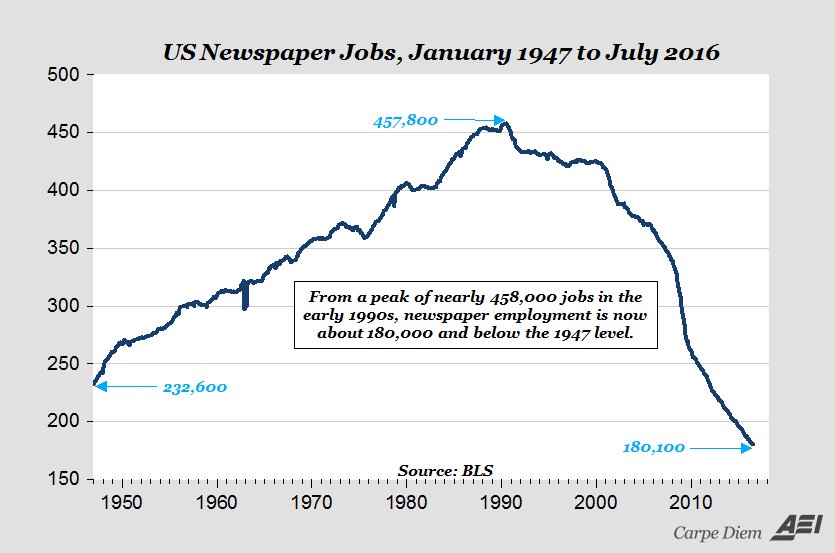
If you want a picture of what utter collapse in an industry looks like, check out the graph above from Professor Mark Perry on employment in the newspaper industry.
From a peak of 457,800 in 1990 to 180,100 in July 2016 is a drop of 60.7%.
North Dakota oil pad. Based on the number of storage tanks, I’ll guess there are going to be a whole lot more than two wells on that site. Photo by James Ulvog.
Here are a few recent energy articles of interest.
Saudi government cuts back wages and benefits for government workers because government revenues are down because government drove down oil prices.
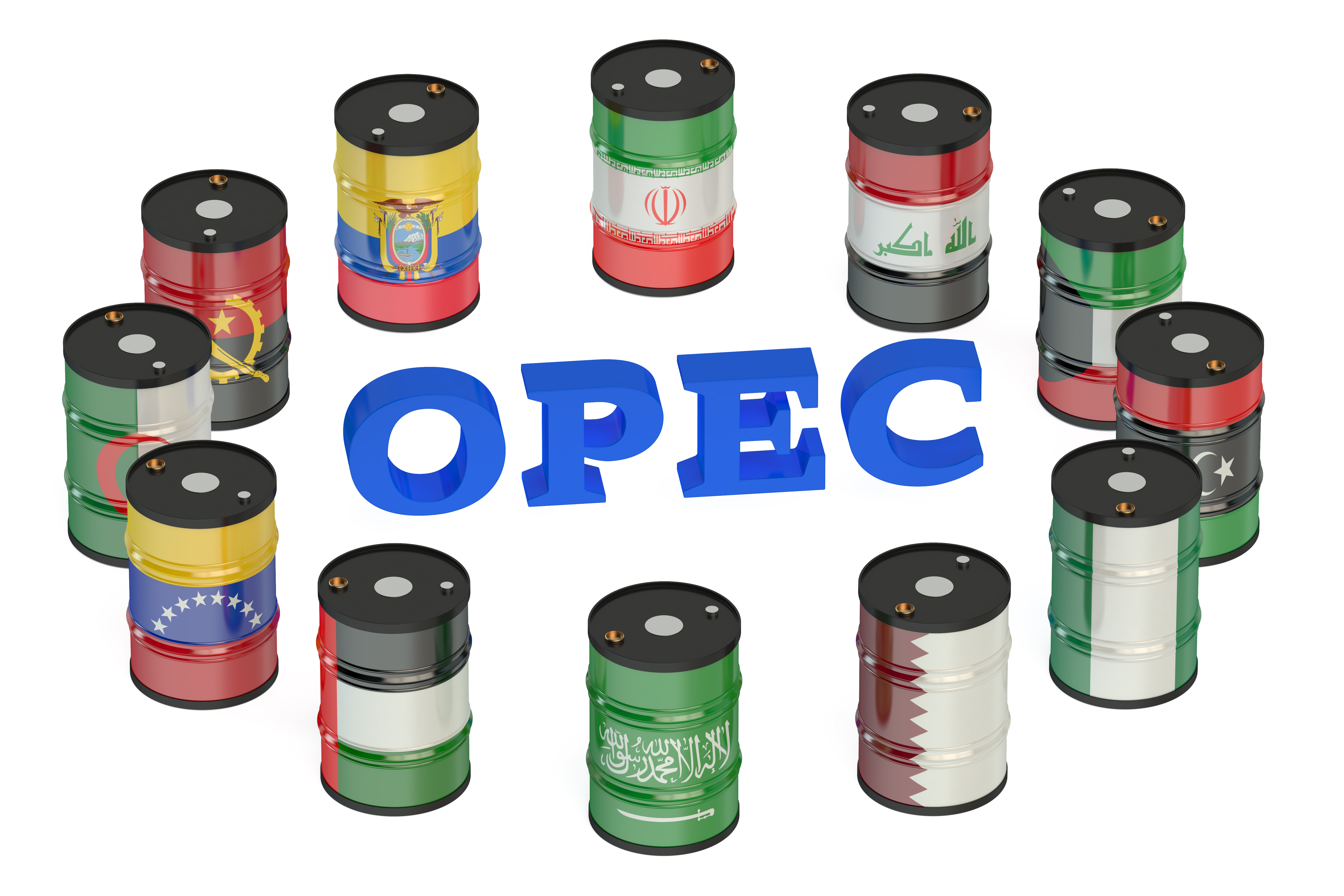
Tentative deal for OPEC to drop production and why it won’t matter.
Shale drillers in the U.S. are ready to increase production.
For those at “ministerial” level, pay will be cut 20%. After looking at a few articles, I’m not sure how many people are at the “ministerial” level.
Purpose seems to be psychological, specifically to tell the financial world that the government is serious about cutting costs.
9/29 – AP at Bakken.com – AP Explains: What does OPEC’s tentative deal mean for oil? – The OPEC producers agreed that they will in the near future agree to a production cut. No cut in sight but they agreed they need to pull back from maximum production by everyone.
The Technology Quarterly issue from The Economist for August 27, 2016 described the open frontier of space. Check out Remaking the sky. I think that’s behind their paywall, so you may need a subscription.
Here are a few cool things I learned.
A sudden light– Nice description of the SpaceX launch when they recovered a booster back at the original launch site. Puts into context what an amazing step it is to recover a booster.
The small and the many– There are four major players in the world of communication satellites: Eutelsat, Inmarsat, Intelsat, and SES.
The typical cost for SES satellites range from $100M up to $300M. The launch cost is in ballpark of $100M. At those prices the entire satellite industry is very risk-averse. I get it. You cannot take a big chance when somewhere between $200M and $400M is on the line.
Tiny satellites, called cubesats, are built in multiples of blocks measured in “1U”, meaning a box 10 cm by 10 cm by 11.5 cm.
Cubesats are revolutionizing the satellite world by dramatically reducing cost and risk. The cost to develop a cubesat is small. One launch can lift a lot of cubesats which drops the cost. They don’t have the power to last very long and don’t have any propulsion, with both factors making it cheaper to experiment and not as risky to something trying something new.
Map of Mali. Image courtesy of DollarPhotoClub.com
Some sadness from Mali along with an encouraging dose of justice.
The branch of Al Qaeda in Mali carried out a terrorist attack in Ivory Coast this past spring.
The lead terrorist who destroyed many cultural artifacts in Timbuktu gets 11 years in prison after a humiliating confession in court.
3/14/16 – Wall Street Journal – Al Qaeda Turns Sights on Africa Success Story– On 3/14, terrorists from al Qaeda in the Islamic Maghreb shot up a beach resort in Grand-Bassam, Ivory Coast, killing at least 15 people. That is the al Qaeda offshoot operating out of Mali that has been terrorizing Mali.
Quoted experts have been concerned that group would start reaching out to economically developed countries, such as Ivory Coast or Senegal.
The attack was in Grand-Bassam, which is about 25 miles from Abidjan.
Ivory Coast has worked hard to achieve an average 9% growth rate over the last four years. Good for the people there and their government!
9/27/16 – Wall Street Journal – Islamist Sentenced to Nine Years for Timbuktu Shrine Destruction – Soldiers of Ansar Dine destroyed Muslim shrines in Timbuktu that are many hundreds of years old. Nine mausoleums in total were destroyed. The door to the Sidi Yahia mosque, so the story goes, hasn’t even been opened in 500 years. All but one of the destroyed sites were on the World Heritage roster of UNESCO.
(Over five hundred years old! Here in California, we are impressed by buildings that are standing 50 or 60 years later. A notable historical restoration project in my city consists of sprucing up a gas station from the ’50s that is on the old Route 66.)
A colony on Mars is no longer just a silly fantasy. It is now in the range of maybe actually possible.
SpaceX announced the outline of their plans for shuttle runs to Mars in order to populate a self-sustaining colony.
Drawing of launch pad ready for launch. Credit: Flickr, SpaceX has placed this in public domain.
My summary of the concept
Here is my simple summary:
A booster rocket, standing 254 feet tall, will have 42 Raptor engines. The Falcon 9 in testing now is powered by 9 Merlin engines. The Raptor engine is three times as powerful as the Merlin. The booster will have thrust twice that of a Saturn V with ability to lift 300 tons into low-earth orbit.
Image courtesy of DollarPhotoClub before they merged into Adobe Stock.
Low oil prices continue to create distress for several governments in the Middle East who need high prices to provide enough goodies to keep the populace happy. Also, some background on the war in Yemen. Last article describes the exploitative labor system called kafala.
Iran (Shia) is backing the rebels, providing lots of smuggled munitions and supplies, including ballistic missiles. The vendors to the Saudis caution there is a chance that a ballistic missile could hit a target. Iran is providing propaganda support, which is effective. There is a lot of fighting.
Minuteman II on static display at March Air Base Museum. Photo by James Ulvog.
I’ve been wanting to put some data on nuclear weapons in print (Yeah, in print isn’t correct, but in pixels just doesn’t sound right).
That way if I want to make reference to some of this info in the future I can point to an unclassified, unverified source for that information. Somewhere in the back of my brain I might remember something I was told on the record so I want to have something in print I can point to instead.
Also, found an article I found disturbing, yet of interest. First the disturbing article:
2/6/16 – The Economist – What lurks beneath– India is hoping to officially commission its first SSBM (a nuclear sub carrying missiles, or SSBN) this week. China reportedly has 4 second-generation SSBNs.
Both countries are trying to dominate their nearby ocean to provide safe operating space for their SSBNs. Article says both their boomers are noisy. That means for the moment they are easy to find.
Just to ponder. Number of SSBNs:
4 – China
1 – India
Article has a graph showing the estimated number of nukes held by India, Pakistan, and China. My interpolation of the graph, rounded to nearest 5s:
Just in case you were wondering, here is a list of the domain name extensions I found that are available at GoDaddy, excluding several that are recognizably related to a specific country. Probably missed a few.