Two more reasons for an oil and gas boom in the U.S. – free market capitalism and private property rights

The two biggest factors driving the tremendous expansion of shale oil and shale gas production are first, hydraulic fracturing and second, horizontal drilling.

There are two more major factors that have allowed this boom to take place, as pointed out by The Wall Street Journal in their editorial, The Shale Gas Secret (behind paywall).

Continue reading “Two more reasons for an oil and gas boom in the U.S. – free market capitalism and private property rights”

More background on privately run trips to the moon

Space.com has good background on Excalibur Almaz, one of the companies working towards private space flight including excursions to the moon, in their article Space Tourist Trip to the Moon May Fly on Recycled Spaceships.

Excalibur Almaz will start with refurbished Russian spacecraft:

It bought four 1970s-era Soviet Almaz program three-crew capsules and two Russian Salyut-class 63,800-pound (29,000 kilograms) space station pressure vessels.

The plan is to lift an Almaz reusable return vehicle and a Salyut space station into Earth orbit separately. Then match them together with a propulsion unit and the combined stack heads to the moon.

Continue reading “More background on privately run trips to the moon”

Lifetime financial data for a typical well in Bakken – revised

Previous posts here and here covered some of the info from a presentation by Mr. Lynn Helms, North Dakota’s Director of Mineral Resources, at the Williston Basin Petroleum Conference on May 25, 2012.

The presentation had more information on the dollar impact of a typical well in Bakken. The additional info allowed me to rearrange the data into an income statement. I am an accountant after all.

I previously discussed this in another post. I’ll refine that analysis in this post.

Here is the income statement for a typical well over a full lifetime of production, based on the data in the presentation. Continue reading “Lifetime financial data for a typical well in Bakken – revised”

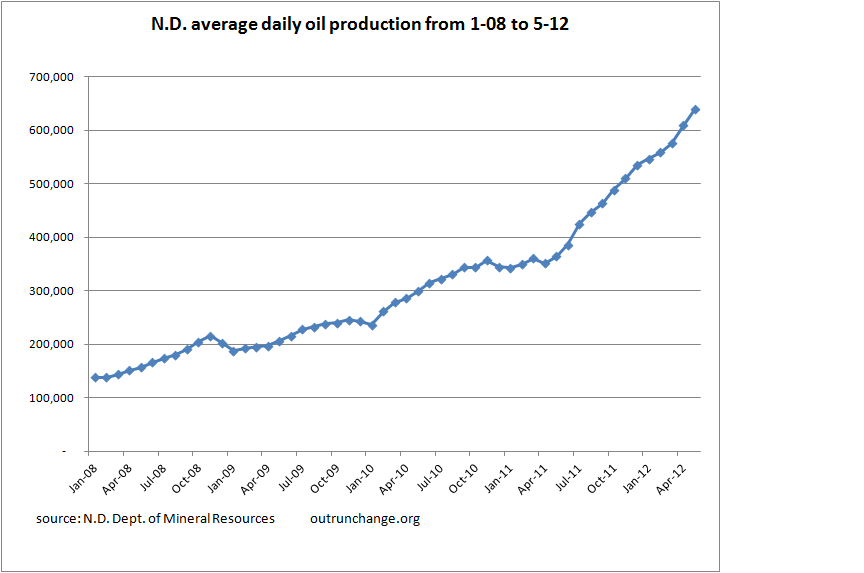
Graph of North Dakota oil production – another record – May 2012

Average daily oil production in North Dakota for May 2012 was 639,277 bopd, which is an increase of 29,904 barrels per day over April, or 4.9%.  The April increase was 33,883 bopd, or 5.9% for the month. Increase in March was 17,235 bopd, or 3.1% over February.

Number of wells increased to 6,954.

You can find the data here.

Here is a graph of monthly production:

For some longer term perspective, here is the production data for the month of May over the last 5 years. Continue reading “Graph of North Dakota oil production – another record – May 2012”

Did you know the U.S. drilled the last drop of its oil two years ago? – peak oil #7

Seriously.

We don’t have any more oil to drill.  Let me prove it to you.

In 2000, we had 21 billion barrels of proved oil reserves. Proved reserves are the amount that is economically and technically feasible to produce.

In 1999 we produced 5.9M barrels a day. Prediction for production in 2000 was 5.8M bopd. That latter number is equal to 2.11B barrels a year.

That means as of January 1, 2000 we had 9.92 years of oil that we could economically and technically get to. In other words, we ran out of oil back in November 2009 or earlier.

Continue reading “Did you know the U.S. drilled the last drop of its oil two years ago? – peak oil #7”

Forecasts for Bakken field. Part 2

Previous post covered some of the info from a presentation by Mr. Lynn Helms, North Dakota’s Director of Mineral Resources, at the Williston Basin Petroleum Conference on May 25, 2012. You can find the PDFs from the presentation here.

Here is some more info I enjoyed from the presentation.

Possible number of new wells in North Dakota

Continue reading “Forecasts for Bakken field. Part 2”

Forecasts for Bakken field. Part 1

Wow. I tripped across the PDF slides for the presentation by Mr. Lynn Helms, North Dakota’s Director of Mineral Resources, at the Williston Basin Petroleum Conference on May 25, 2012. You can find the presentation on this page. The title is WBPC Activity.

A big thank you to Mark J. Perry at Carpe Diem for pointing me to the PDF slide presentation.

Mr. Helms presentation is the source for many of the articles I’ve read and the resulting posts on this blog.

What is the very condensed message from the presentation?

The oil boom in North Dakota, which has seen production skyrocket to over 600,000 barrels per day, is just getting started.

Typical production from a well

Continue reading “Forecasts for Bakken field. Part 1”
ND oil production 1M bopd by 2015 or 2019

I’m going to start accumulating estimates of when North Dakota oil production will pass the 1 million barrels per day mark.

Prairie Business reports in ENERGY: 1 million barrels possible an estimate that ND production will be 1M bopd by 2015.  James Volker, chairman and CEO of Whiting Petroleum Corp., makes that prediction.

A plateau of 800K bopd is more likely, according to Alison Ritter, public information specialist for the North Dakota Department of Mineral Resources.  According to the article:

Ritter adds that the department sees the 1 million barrels per day as a possible scenario. The probable scenario is 800,000 barrels a day.

3 scenarios for production

Continue reading “ND oil production 1M bopd by 2015 or 2019”

What portion of U.S. based drilling rigs are in Bakken and Eagle Ford?

25%.

One-fourth of the active rigs in the U.S. are located in those two areas.

There are 1,959 rigs working as of June 29, 2012. As I mentioned here, there are 215 rigs in Bakken and 278 in Eagle Ford. That means 11.0% of the U.S. rigs are in Bakken and 14.2% are in Eagle Ford. That totals to 25.2% of U.S. rigs in two plays.

I got to wondering what portion of the national drilling was in those two areas. A few minutes of research gave me plenty of info.

Continue reading “What portion of U.S. based drilling rigs are in Bakken and Eagle Ford?”

Two companies moving forward with moon tourism

The Economist reports in their article Fly me to the moon that two companies are moving forward with tourist trips to the moon.

The article lays out the playing field as follows:

On June 19th Excalibur Almaz, a space company based on the Isle of Man, a British dependency in the Irish Sea, became the second company—after Space Adventures, an American space-tourism firm—to offer tickets for a commercial moonshot.

Price tag?

Continue reading “Two companies moving forward with moon tourism”

Try a new thing three times before you decide whether you like it

Try a thing you haven’t done three times.

Once, to get over the fear of doing it.

Twice, to learn how to do it.

And a third time to figure out whether you like it or not.  

Multiple internet sites attribute this to Virgil Thomson, American composer.

I’ve been pondering that quote over the last week or so. Lots of wisdom there. Doesn’t apply to everything, but it has lots of value for many situations, especially when dealing with radical change.

Back of the envelope calculation for the total drilling investment per month in Bakken and the possible revenue over the next year

Here is a wild guess on what a month’s worth of production might cost and the value of oil produced in the next 12 months for the Bakken field.

The drillers are investing far more than a billion dollars per month. My estimate is the new wells drilled in one month will produce gross revenue for the next year’s production in the range of 1 billion or 3 billion dollars.

Continue reading “Back of the envelope calculation for the total drilling investment per month in Bakken and the possible revenue over the next year”

Official estimate of Williston population grows 9% in 2011

The Williston Herald describes the Census Bureau’s estimate of 2011 population for North Dakota and key cities in their article Census estimates indicate growth in ND oil patch.

The article says the official estimates are that Williston and Watford City grew by 9% in 2011. 

Official count for the state is 683,932.

Although this is the official data, the real count is likely far higher. The changes in the oil patch are running too fast for the estimates to keep up.

Continue reading “Official estimate of Williston population grows 9% in 2011”

In terms of hours labor it took to pay for a stamp, what was the cost to send a half-ounce letter cross-country on the Pony Express? Would you believe about half the cost to send yourself across the country now?

While touring the Wells Fargo Museum in San Diego, I enjoyed their description of the Pony Express. Of course I had to convert the cost of mailing a letter to now.

According to the museum, the Pony Express ran from April 1860 to October 1861. From April 1861 until October, Wells Fargo ran the Pony route west of Salt Lake City. However, they set the rates and printed stamps for the entire cross-country run.

Wells Fargo reduced the rate to $2 per ½ ounce and then cut the rate further to $1 per ½ ounce.

In terms of average pay of the time, that is equal to about half a ticket to fly from Missouri to San Francisco today.

Let me explain.

Continue reading “In terms of hours labor it took to pay for a stamp, what was the cost to send a half-ounce letter cross-country on the Pony Express? Would you believe about half the cost to send yourself across the country now?”