Question about North Dakota oil production: will the trends of the last six months continue forever?

How much new housing will Williston need in the next few years? Photo by James Ulvog.
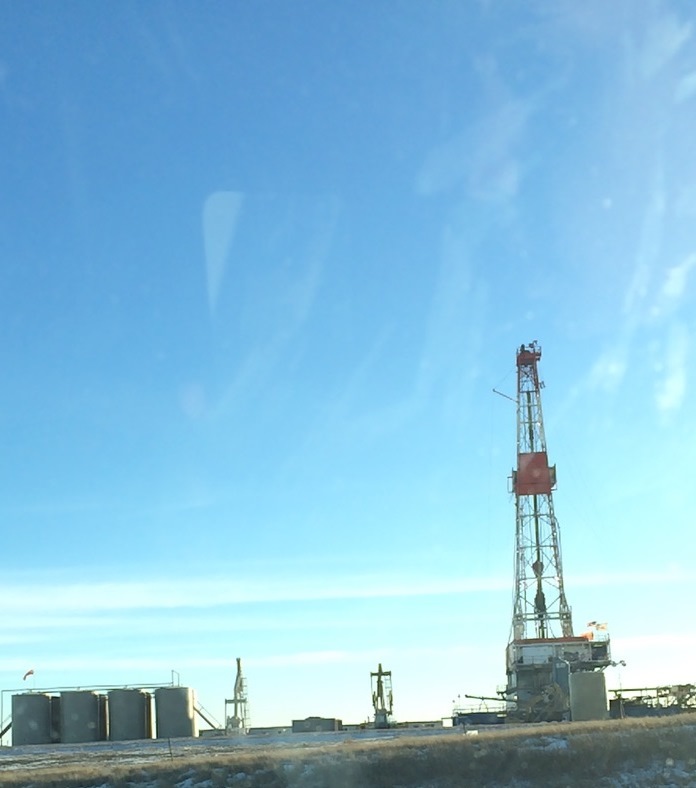
How much new housing will Williston need in the next few years? None? Some? A lot? Photo by James Ulvog.

A recurring human foible I see is making an assumption that the immediate past trends will continue in a straight line forever.

In the context of crude oil in general and western North Dakota in particular, the question is whether the slump of the last year will continue for an indefinite period of time (measured in years or even decades) or will there be surges in production at various points?

City officials in Williston give every indication of thinking that the boom is over and will never return. Seems like they are preparing for life in the city and surrounding area to have current level of employment plus only slow growth for decades.

I think that reasoning is why there is opposition from public officials to expanding the airport. Why spend any money on a new airport when you don’t need the extra capacity this afternoon and for the rest of the week? There is no reason to go through all the effort of tearing up farmland when the current airport is sufficient for traffic this month. There are open seats on flight to Minneapolis. Why, I’ll bet the airlines could even add a flight or two if they actually get more customers.

Why not chase all the crew camp facilities out of town? They are not needed. There is enough capacity in apartments and hotels to absorb the number of people who are in crew camps this month, so what purpose is there for ever again having any crew camp capacity in the city? Just force the temporary workers who don’t know how long they will be in the area to sign a one-year lease and everything will be fine. In the alternative, they can just stay in hotel that will only cost $3,000 or $3,500 or more per month. Problem solved.

If you assume that oil prices will stay where they are today for the next several decades and if you assume the number of rigs in North Dakota will stay in the range of 20 or 30 or 40 for a decade or two then you should plan for a city with population at about the current level.

If you assume the trends of the last 12 months will continue for decades, then there is no need for new facilities.

What size is Williston going to be?

On the other hand….
Continue reading “Question about North Dakota oil production: will the trends of the last six months continue forever?”

More statistics for North Dakota oil production, April 2016

[youtube=https://www.youtube.com/watch?v=c9nnsAGyQ2k]

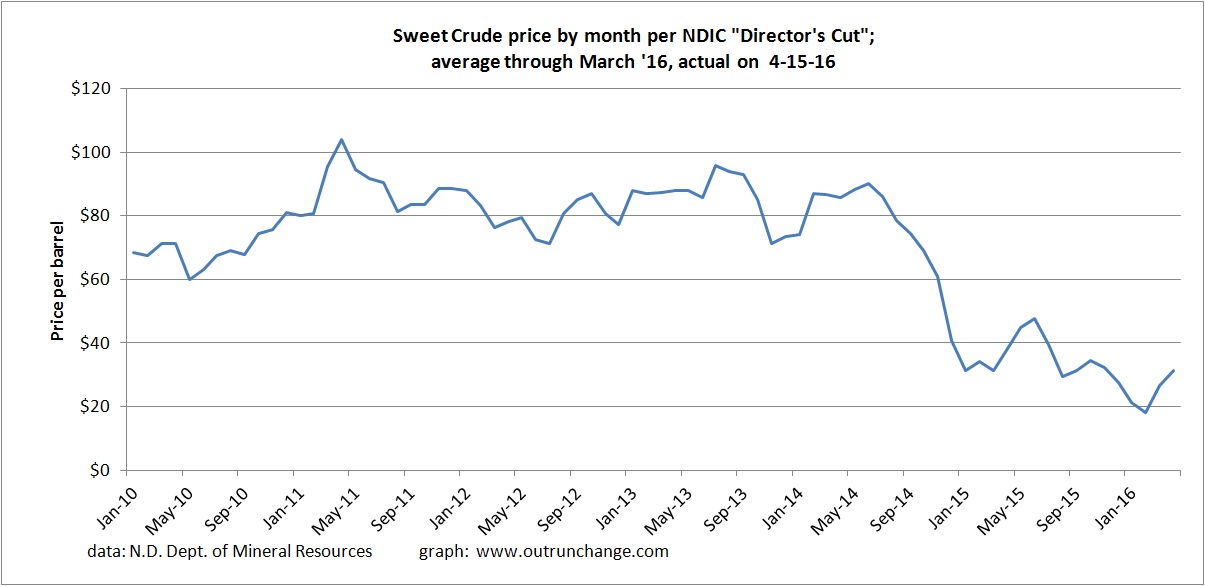
Rounding out the picture of North Dakota oil production based on data released by the state on April 15, 2016, here is a graph of the sweet crude prices in North Dakota from January 2010 through April 2016. Quite visible is the dramatic drop in late 2014. Of particular note is prices have recovered in the last two months.

Next is a graph of the rig count by month. You can also see a dramatic drop starting the end of 2014.

Finally is a graph of the fracklog from January 2012 through February 2016. This is the number of wells that have been drilled yet are uncompleted (DUC) meaning the well is drilled to total depth but the fracking has not yet been done. Basically this is a half million barrels of oil put on the inventory shelf until prices recover. That represents nearly a thousand wells than can be brought on-line rather quickly.

average price by month thru 4-16

Continue reading “More statistics for North Dakota oil production, April 2016”

OPEC+Russia meeting on Sunday may freeze production at currently high levels

Image courtesy of DollarPhotoClub.com

Reports have been in the media for a long time that OPEC will have an unscheduled meeting to discuss production levels. The meeting is tomorrow, 4/17/16.

Finally read an article that makes some sense of why there should be a meeting to freeze production at the currently high, pump-everything-you-can levels which are sustaining the world-wide oversupply.

Continue reading “OPEC+Russia meeting on Sunday may freeze production at currently high levels”

Oil production in North Dakota barely drops in February 2016

[youtube=https://www.youtube.com/watch?v=0ks2ua4imgU]

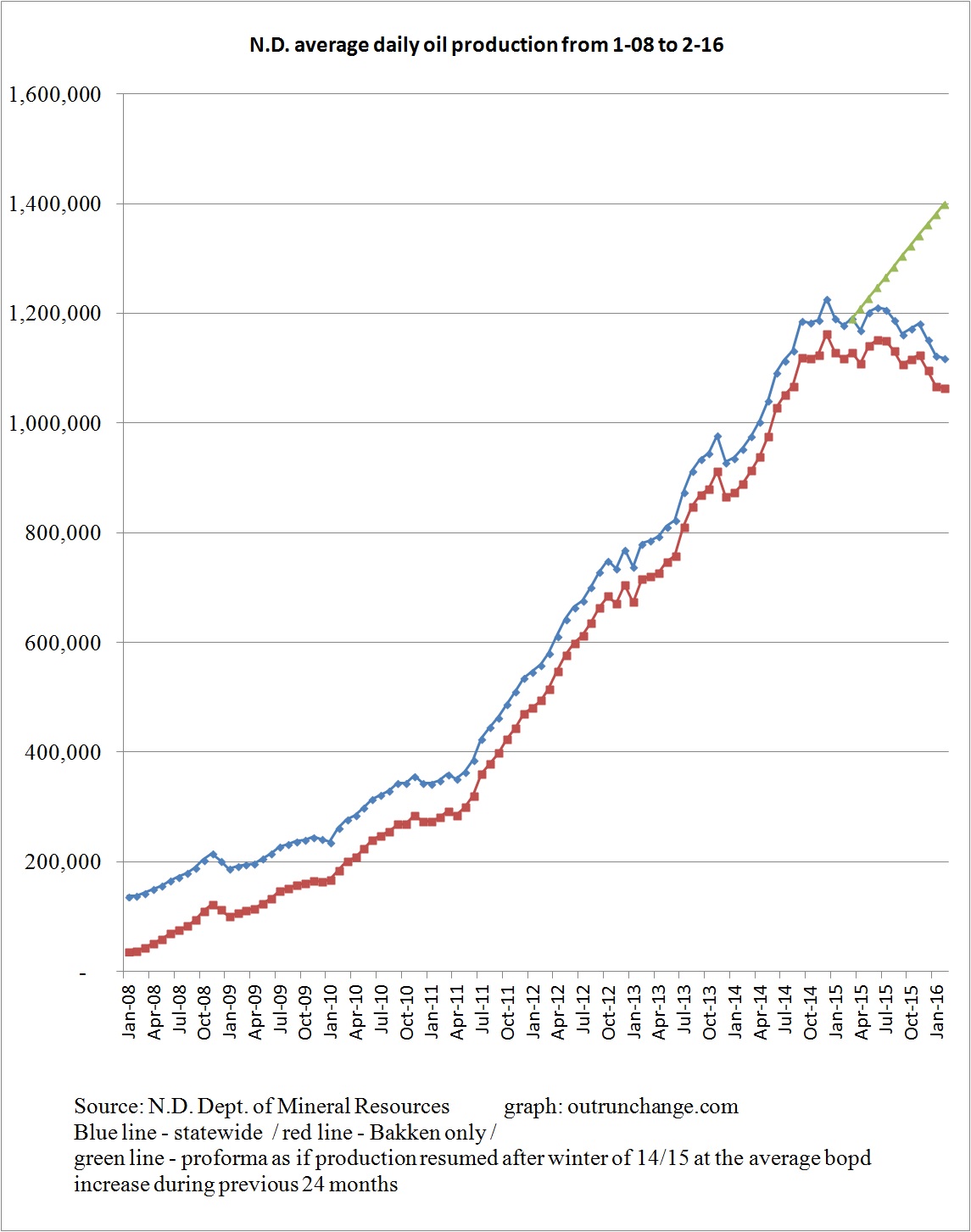
Average daily production dropped to 1,118,333 bopd (Prelim) in February from 1,122,462 (revised +352 bopd) in January. That is a mere 4,129 bopd decline, or 0.37%.

Here are a few graphs to paint the story. First average monthly production from 2008 through February 2016 showing total for the state and Bakken field only. Included in that graph is a pro forma of what production would have been (based on my wild guess) if the production increased after the winter at the average rate of increase over the preceding 24 months.

Second graph is average production in the state since 1990. Finally, to show the change since 2010 more dramatically is a graph of production since 2004.

ave production 08 to 2-16

two more follow:

Continue reading “Oil production in North Dakota barely drops in February 2016”

Oil market – Update on Saudi Arabia

Ras Tanura oil terminal, Saudi Arabia. Photo courtesy of DollarPhotoClub.com

I have a backlog of energy articles to discuss. Will start posting some of them, starting with the precarious position of Saudi Arabia.

3/29 – Financial Times (I think) at RT.com – Saudi Arabia loses oil market share in key countries – Russia and Iran are pricing and marketing aggressively around the world. So much so that Saudi Arabia has dropped back from the largest exporter in nine out of the 15 largest markets. That loss has taken place over the last three years.

4/12 – AP at Bakken.com – Weak oil prices prompt Fitch to cut Saudi Arabia’s ratingContinue reading “Oil market – Update on Saudi Arabia”

How easily can US shale oil bounce back?

Will we see bunches of those soon? Yes, no, maybe so.

Will production of shale oil recover as oil prices rise? I’ve seen several articles discussing whether that can or will happen. Three articles saying yes, no, and maybe so.

Yes.

2/29 – Reuters at CNBC – US shale’s message for OPEC: Above $40, we are coming back – Multiple comments indicate that $40 oil today is like $70 oil a year ago.

Continental Resources says will start drilling if US crude increases to mid $40 range. Whiting Petroleum will start completing DUC wells if oil is in the low 40s. A year ago comments were that companies would start increasing the drilling if oil hit $70.

Article says Hess reduced the cost of a new well by 28% over the last year.

EOG says they have these rights for 3,200 wells which would produce a rate of return of 30% when oil is at $40.

Implication of these comments is shale production would likely ramp up when prices move into the 40s, perhaps more likely the high 40s. That would create substantial pressure on worldwide oil prices, keeping them from rising too far.

No.

3/15 – Wall Street Journal – Many Shale Companies Are Unable to Ramp Up Oil Output – Article raises a great point that just as output from shale oil has fallen slower than anyone expected, there are different reasons that shale producers may be challenged to ramp up production when prices increase.

Continue reading “How easily can US shale oil bounce back?”

Continued deterioration in the Venezuelan economy – 3

Image courtesy of DollarPhotoClub.com

The citizens of Venezuela continue to suffer at the hands of their elected officials.

Question for you to ponder: Is there a particular economic system that is causing all the suffering?

2/29 – AP at Fox News – Inflation-hit Venezuela to print bigger bills – Central Bank president says Venezuela will start printing 500 and 1,000 bolivar notes sometime. No date mentioned.

Largest bill in circulation is currently the 100 note. At exchange rates in effect a month ago or so, that would be worth about US$0.10. Largest bill in circulation is equal to about one American dime.

How can an economy function in such circumstances? Not very well.

3/4 – According to dolartoday.com, the exchange rate is 1,105 bolivars to the dollar. That means 100 bolivars is 9.05 cents.

3/18 – Exchange rate is 1,211, or 100 bolivars is 8.25 cents.

3/18 – Foundation for Economic Education – What Did Venezuela Use Before Candles? Electricity.

Continue reading “Continued deterioration in the Venezuelan economy – 3”

2 more successful recoveries of space boosters

As Behind the Black likes to say, the competition heats up. Very cool.

4/3 – Tech Crunch – Blue Origin releases video from third launch and landing of New Shepard – Blue Origin successfully launched and recovered a booster again. This is the third launch and landing of that specific lift vehicle.

Blue Origin is Jeff Bezo’s space company.

The video:

[youtube=https://youtu.be/YU3J-jKb75g]

4/7 – Wall Street Journal – SpaceX Lands Portion of Spent Rocket on Floating PlatformSpaceX nailed the landing of its booster on a floating platform. They have had four failures to recover at sea and one successful recovery back on land (which required a lot of extra fuel). Was just a matter of time until they nailed it.

I do hope it will now become the norm to recover the lift stage.

Behind the Black provided the best link to video I’ve seen yet:

[youtube=https://youtu.be/sYmQQn_ZSys]

Oh, this launch also successfully delivered a load of cargo to the ISS. Delivery of cargo to space by private companies is old news. Still extremely cool.

When we think through an issue far enough to develop a considered opinion, that gives us a bias that everyone else is wrong.

Image courtesy of DollarPhotoClub.com

Ponder the implications for how you look at the world:

When you have developed a perspective or opinion or conclusion on some issue after having thought through all the relevant factors, there is a serious danger that reaching such a conclusion leaves you thinking that anyone with a different perspective is incorrect.

If your carefully drawn, considered opinion is reasonable, then the inference is that other opinions aren’t reasonable.

Continue reading “When we think through an issue far enough to develop a considered opinion, that gives us a bias that everyone else is wrong.”

Continued drop in count of working oil rigs in North Dakota

Photo by James Ulvog.

Here is a recap of the North Dakota rig count, all from Million Dollar Way. Also, an article quantifying the impact on employment from the drop in rig count.

Some older data repeated for recent context: Continue reading “Continued drop in count of working oil rigs in North Dakota”

Cool stuff on the open frontier of technology

A few fun things I’ve seen lately. Amazon opens its 7th fulfillment center in California. Animated short that is close to photo quality. GIF showing how applications have displace everything on a circa 1990 work station.

3/15 – Behind the Black – Check out this animated video. Consider the question raised by Behind the Black – with this quality of animation, how soon until human actors aren’t needed because an apparently live action movie can be 100% animated?

[youtube=https://youtu.be/nPrWo5pEvyk]

3/30 – DailyBulletin (Inland Empire area of LA) – New Amazon fulfillment center coming to San Bernardino, to add 1,000-plus jobs – This will be the seventh facility in California. San Bernardino is about 60 miles east of downtown LA. Amazon locations in the state: Continue reading “Cool stuff on the open frontier of technology”

What ails the newspaper industry?

Image courtesy of DollarPhotoClub.com

Recently read several articles pondering what is going on in the collapse of newspaper revenue and the collapse in circulation. One is a lamentation over the loss of life-long career opportunities. Another describes doubling down as strategy to survive. Finally, a different idea on what might be driving the collapse in circulation.

3/2 – The Nation – These Journalists Dedicated that Their Lives to Telling Other People’s Stories. What Happens When No One Wants to Print Their Words Anymore? A heartsick lament that bemoans the drop from 55,000 full-time journalists in 2007 to 32,900 in 2,015. That drop of 22,000 doesn’t include big layoffs in 2016.

The shrinkage will likely continue – A J-school prof at USC thinks if trends continue for the next three years like the last three, there could be somewhere between one-third and one-half of the 50 largest papers disappear.

Continue reading “What ails the newspaper industry?”

On learning to surf the waves of change

Image courtesy of DollarPhotoClub.com

We need to figure out how to ‘surf’ the massive waves of changes surrounding us.

This discussion, cross-posted from my other blog Attestation Update, helps all of us get a picture of the massive amounts of change surrounding us and the huge waves of change that are getting closer.

3/24 – Tom Hood on LinkedIn – Why Accountants Must Learn How to Ride These Big Waves of Change – There are massive waves of change on the horizon. Risks of getting drowned are high for accountants and auditors.

We need to understand what those two comments mean and how to cope with the implications. Tom Hood’s article points toward those waves that are soon to crash down on our heads.

It’s a VUCA world

Major changes we are in can be summarized by that phrase: Continue reading “On learning to surf the waves of change”

Income statement for LAX airport

Image courtesy of DollarPhotoClub.com

The Los Angeles city controller is working to put all financial activity for city agencies on-line, down to the invoice level.

Most recent agency’s financial statements to go online is LAX, the airport.

3/24 – Wall Street Journal – Follow the money at LAX

Here is the income statement for LAWA, the airport authority. All amounts in millions of dollars: Continue reading “Income statement for LAX airport”

Update on OPEC strategy

Image courtesy of DollarPhotoClub.com

Fascinating to watch news in February about OPEC’s strategy. First, IEA sees a drop of US shale oil in 2016 and 2017 with strong growth in output over the following four years.

I have quite a backlog of lot of articles on energy to discuss. Will try to get caught up. Here goes…

Article at the end of January indicated OPEC is publicly claiming things are going swimmingly well. Then Saudi Arabia and Russia agreed to freeze their production at the January level, which is near record level of output for both countries. Then the end of February OPEC’s secretary-general acknowledged that the intentional goal was to wage a price war against US shale. Also acknowledged the price war hasn’t worked like they planned.

I don’t think that crippling the Russian, Saudi Arabian, and Venezuelan national budgets by dropping prices about 60% with no near-term expectation of recovery is quite what they had in mind.

2/22 – IEA sees oil market rebalancing in 2017; US production at record high by 2021 – The IEA forecasts that US production of light tight oil will fall 600k bopd in 2016 with another drop of 200k bopd next year. Forecast predicts an increase of 1.3M bopd over 2015 levels by 2021.

Continue reading “Update on OPEC strategy”